Rock landscaping in San Diego often mixes decomposed granite, boulders, and gravel. That can cut irrigation compared with turf. It does not automatically qualify for a turf rebate. Confirm plant-coverage rules and reservation on the current SoCal Water$mart estimator. Bloom Pro SD does not publish material rate cards.
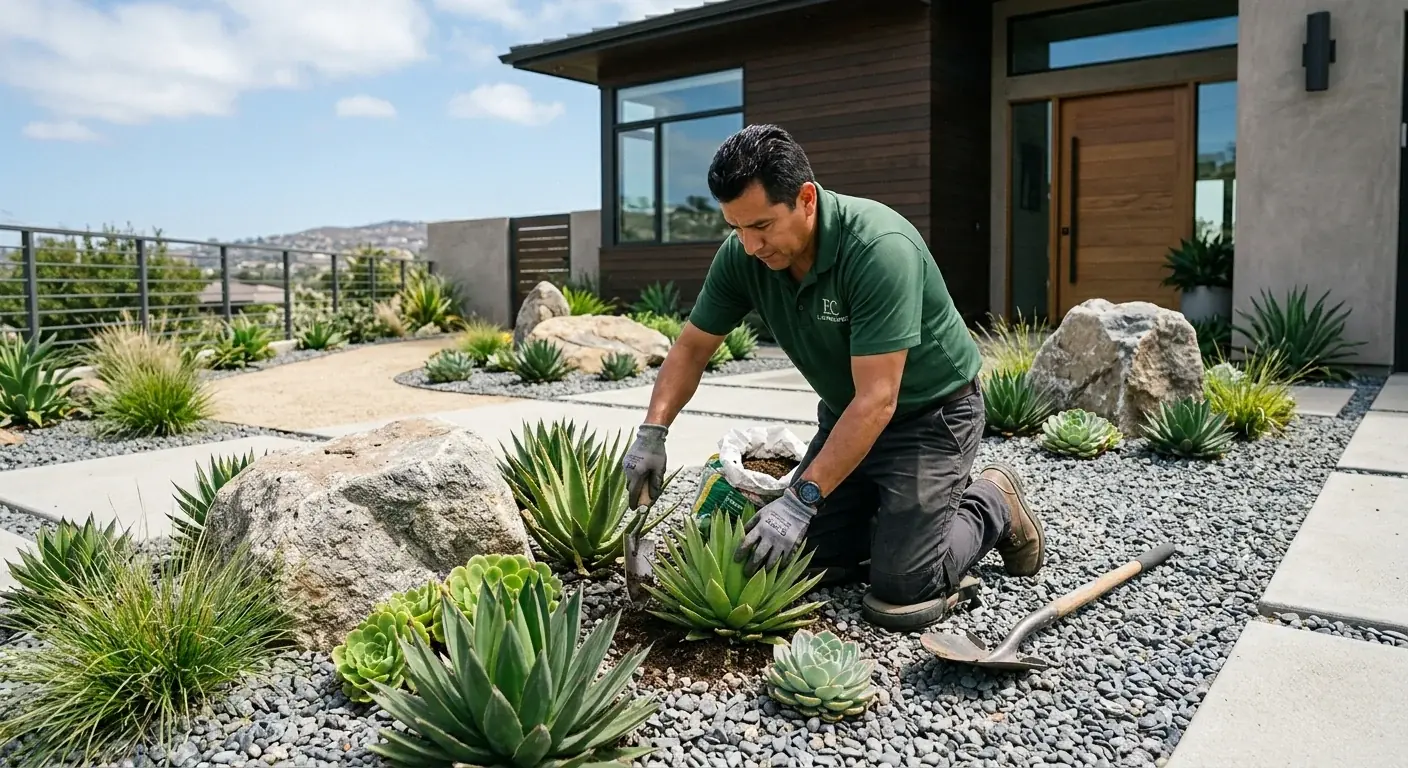
Rock types: what each one does and what it costs
Different rocks solve different problems. Here’s how the main options stack up for San Diego yards:
Pricing is set by the independent licensed contractor after they see the site. Bloom Pro SD does not publish installed rates. Compare itemized bids that name materials, quantities, access, demolition, and who handles permits or rebates.
| Quote field | Why it changes the number |
|---|---|
| Measured area or linear footage | Sets material and labor time |
| Access, slope, and demolition | Often larger than the visible finish |
| Product or material specified | Brand, size, and finish must match across bids |
| Base, drainage, and restoration | Frequently omitted from low totals |
| Permits, engineering, or rebate filing | Confirm who owns the paperwork |
Access, grading, and weed barrier change install hours. If you are replacing live turf, use the current SoCal Water$mart estimator. A rock-only conversion typically fails plant-coverage rules. Synthetic turf is not eligible on the regional path.
Decomposed granite: the workhorse of San Diego hardscaping
DG is the most versatile material the crews we match you with install. It’s permeable (rainwater soaks through instead of sheeting off), it compacts to a firm, walkable surface with a stabilizer added, and it blends naturally into the warm Mediterranean palette most SD neighborhoods favor.
Use it for patios, fire pit surrounds, front-yard groundcover replacing a lawn, and informal pathways. Golden-tan DG suits warm-tone stucco homes. Gray-stabilized DG reads more contemporary against white or charcoal exteriors.
One honest downside: unstabilized DG tracks into the house and scatters on windy days. Use a polymer stabilizer for any surface people walk on regularly, and plan to rake it back into shape after heavy rain.
Boulders and lava rock: focal points and slope control
Large boulders earn their cost in San Diego yards because they serve two jobs at once. Placed on a slope, they slow erosion and create planting pockets where succulents and native shrubs can root and hold soil. In a flat front yard, a grouping of three boulders in varying sizes (roughly 2:3:5 ratio) creates an anchor that anchors the design without needing much else around it.
The key to naturalistic boulder placement: bury at least one-third of each boulder in the ground and orient the largest face away from the house. Boulders that sit on top of the soil look dropped, not placed.
Lava rock is a good fit for planting beds along the coast (Encinitas, Carlsbad, Oceanside) where its porous surface holds some moisture and stays cool. Inland, Escondido, El Cajon, Santee, it absorbs heat faster, so pair it with heat-tolerant plants like agave and echeveria, not anything that wilts in reflected heat.
Dry creek beds and drainage: rock as a functional design move
San Diego’s clay soils drain slowly. A well-graded dry creek bed solves a drainage problem and looks intentional doing it. Run it from a downspout or a low spot in the yard to the street or a planted swale. Size the bed to match the catchment area, a bed that’s too narrow will overflow in a hard rain, a common mistake on lots with any grade.
Use a combination of large river rock (4–8 inches) along the center and smaller gravel on the margins. This mimics a real streambed and slows water velocity where you need it most. For a deeper look at river rock specifically, sizes, costs, and installation details, see our guide to river rock landscaping in San Diego.
SD-specific design considerations
Turf rebates: Replacing grass with rock (plus drought-tolerant plants covering at least 50% of the converted area) qualifies for rebates through local water agencies. Get your landscaper to photograph before and after and submit within the window, rebates don’t apply retroactively. More on that: drought-tolerant landscaping costs in San Diego.
HOA approval: Most San Diego HOAs approve rock conversions but require a planting plan alongside them, pure gravel yards are often declined. Pair your rock groundcover with native shrubs, ornamental grasses, or succulents to satisfy the “living material” requirement most CC&Rs include.
Slopes and canyon-edge lots: Decomposed granite alone doesn’t hold on grades above 2:1. On steeper slopes, use larger angular crushed rock or boulders, and consider a weed barrier staked into the slope beneath them. Our hardscaping services include slope-stabilized installations that pass county grading inspection.
Coastal vs. inland aesthetics: Coastal yards (La Jolla, Del Mar, Encinitas) suit lighter tones, white or buff gravel, light-grey DG, rounded river rock. Inland yards (Rancho Bernardo, Poway, El Cajon) can handle warmer earthy tones and larger angular rock without looking heavy. Salt air along the coast means some stone sealers don’t last, skip them on coastal jobs.
Weed management: Rock doesn’t stop weeds on its own. A quality commercial-grade weed barrier under rock groundcover is essential. Budget for pre-emergent herbicide applied at installation. Without it, Bermuda grass rhizomes push through the barrier within a season. For a full comparison of rock versus mulch for weed control, see our post on mulch types for San Diego beds.
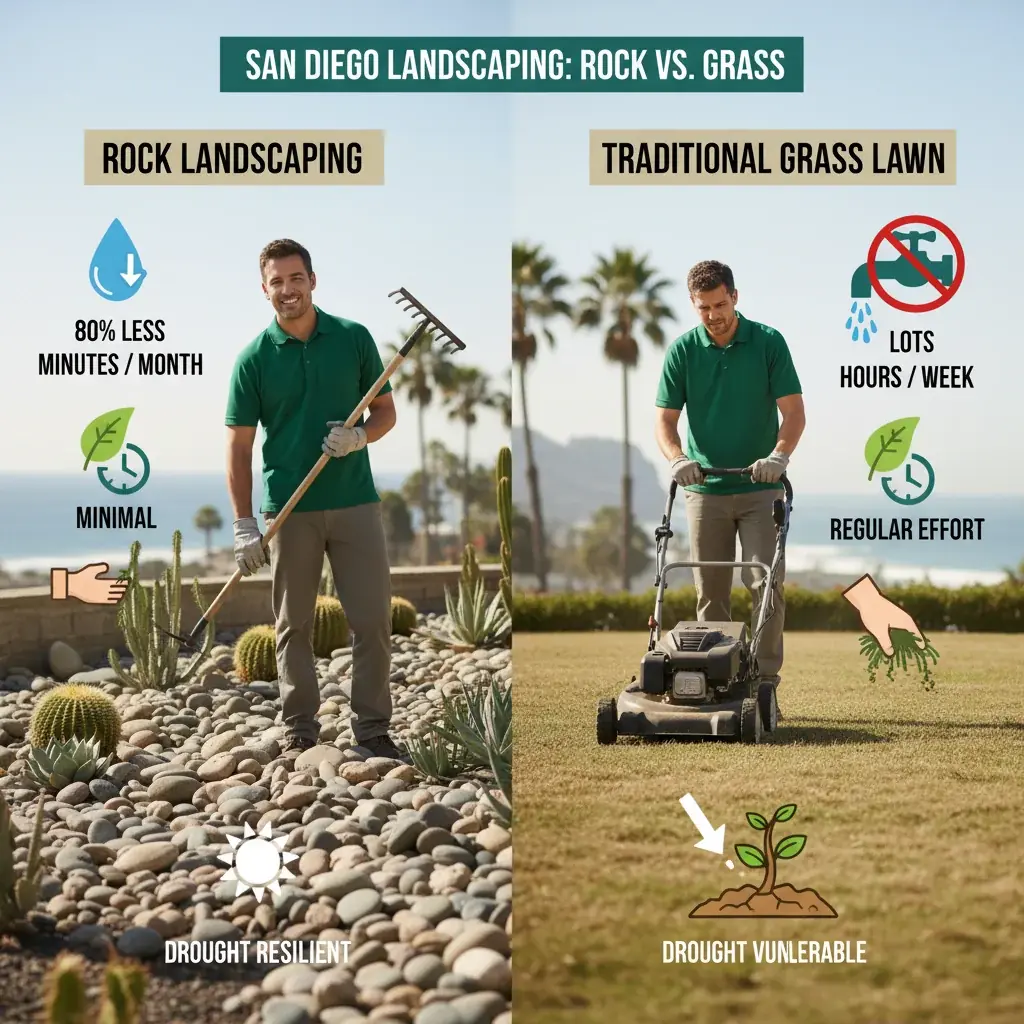
Combining rock with drought-tolerant plants
Rock and low-water plants are a natural pairing in San Diego. The rock layer holds soil temperature stable, suppresses weeds, and reflects light onto surrounding plants, which is ideal for most native and Mediterranean species.
Good combinations:
- DG groundcover + agave + palo verde tree, the classic inland contemporary look
- River rock border + California fescue + lavender, coastal Mediterranean that stays green year-round
- Boulder cluster + trailing rosemary + kangaroo paw, low-maintenance slope cover with seasonal color
- Lava rock mulch + succulents, modern minimal that reads well in HOA neighborhoods
Avoid planting anything with shallow, spreading roots directly against boulders, the rock holds heat and can cook roots during summer. Leave a 6-inch ring of soil around each boulder.
For planting ideas that pair well with rock designs, our drought-tolerant landscaping services page covers the plant side of the equation.
Frequently asked questions
What’s the cheapest rock for landscaping in San Diego?
Decomposed granite is often the lower material line. Crushed base gravel looks rougher and belongs under DG more than as a finish. River rock and boulders cost more per area but can be used in smaller quantities. Ask the yard for delivered tons and coverage at the specified depth.
Is rock better than mulch for San Diego landscaping?
Rock wins on longevity, it doesn’t decompose, won’t blow out in Santa Ana winds, and doesn’t need annual topping off. Mulch wins on soil health, it breaks down and feeds the soil food web, which benefits plants long-term. The practical choice for most SD yards: rock groundcover in open areas and paths, organic mulch directly around plant root zones where soil biology matters. Rock is also required (not optional) for qualifying for most local turf-removal rebates, since rebate programs require a permanent non-living groundcover.
What rock holds up best in a drought-tolerant yard?
For groundcover, stabilized decomposed granite or crushed gravel holds up well across SD’s range of conditions. For mulch around plants, lava rock retains some moisture and stays cool enough not to stress roots. River rock works well in dry creek beds and drainage areas. The rock type matters less than the installation, a quality weed barrier, proper depth (2–4 inches), and clean edging make any rock groundcover perform well for years.
How do I keep weeds out of rock landscaping?
Use a commercial-grade woven landscape fabric (not plastic sheeting, which traps heat and fails faster) installed before the rock. Apply a pre-emergent herbicide at installation and again each spring. Spot-treat any weeds that push through with a contact herbicide rather than pulling, which disrupts the barrier. Bermuda grass rhizomes are the main enemy in San Diego, if your yard has Bermuda, kill it thoroughly before installing the barrier or it will return through any gap.
Do rocks make a yard hotter in San Diego?
Light-colored gravel (buff, white, grey) reflects sunlight and stays relatively cool. Dark materials, decomposed granite in dark shades, lava rock, black basalt, absorb heat and can raise the temperature of the microclimate around them by 5–15°F on hot inland days. For coastal yards and for areas near windows or outdoor seating, stick to lighter tones or use boulders with plants to break up the heat-absorbing surface. In hotter inland climates like Escondido or El Cajon, this consideration matters more than it does at the coast.
Does rock landscaping increase home value in San Diego?
A well-designed rock conversion improves curb appeal, which is the most direct driver of value at point of sale. Rock landscaping also signals low-maintenance and water-efficiency to buyers, increasingly important in Southern California. Buyers understand the ongoing cost of keeping turf alive here. There’s no precise ROI number for rock landscaping specifically, but drought-tolerant front-yard designs consistently perform well in San Diego’s market, particularly in neighborhoods where most yards already have them.
When to call us
Rock landscaping involves more than spreading stone. Proper grading, drainage planning, weed barrier installation, and material selection all affect whether a yard looks great in five years or becomes a weed-and-mud problem. The pros we match you with handle the full scope, from slope assessment and material selection to final installation. Call us at (760) 400-6355 to get matched. The independent professional quotes the work.