Santee runs some of the hottest summer temperatures in the county outside the true backcountry, and most of the neighborhood was built out in the 1990s and 2000s, which means a lot of original lawns are now at or past their first real renewal point. Between the heat load and the age of the turf, Santee lawn care tends to be more about triage and rebuild than simple upkeep. Bloom Pro SD matches Santee homeowners with licensed independent landscapers. Here is what recurring service looks like in East County heat, and where these lawns typically struggle.
Why Santee lawns need a different approach
Santee summer highs run well above what coastal San Diego sees, and that heat load punishes cool-season grass fast. Fescue, common in older tract landscaping, simply cannot hold up through a full Santee summer without heavy water input, which is part of why so many original lawns here look thin or stressed by August.
Water source adds a second complication. Santee is served primarily by Padre Dam Municipal Water District, and hard water is a known local issue, meaning mineral deposits build up on hardscape and can affect sprinkler performance over time as heads and emitters accumulate scale.
The age of the neighborhood is the third factor. Most Santee tract landscaping went in during the 1990s to 2000s boom, and that original irrigation and turf is now old enough that a lot of it is reaching the point where renewal, not repair, is the honest recommendation. Old spray systems waste enormous water through overspray and pressure mismatch, and grass planted 25-plus years ago is often not the best-suited variety for the heat this area actually sees.
What lawn care looks like in Santee
For lawns still in reasonable shape, our lawn maintenance route covers mowing at the right height and season, edging, trimming, and blowdown, same as anywhere in the county. Given the heat, mow height runs slightly taller here than a coastal lawn would need, since taller grass shades the soil and reduces evaporation.
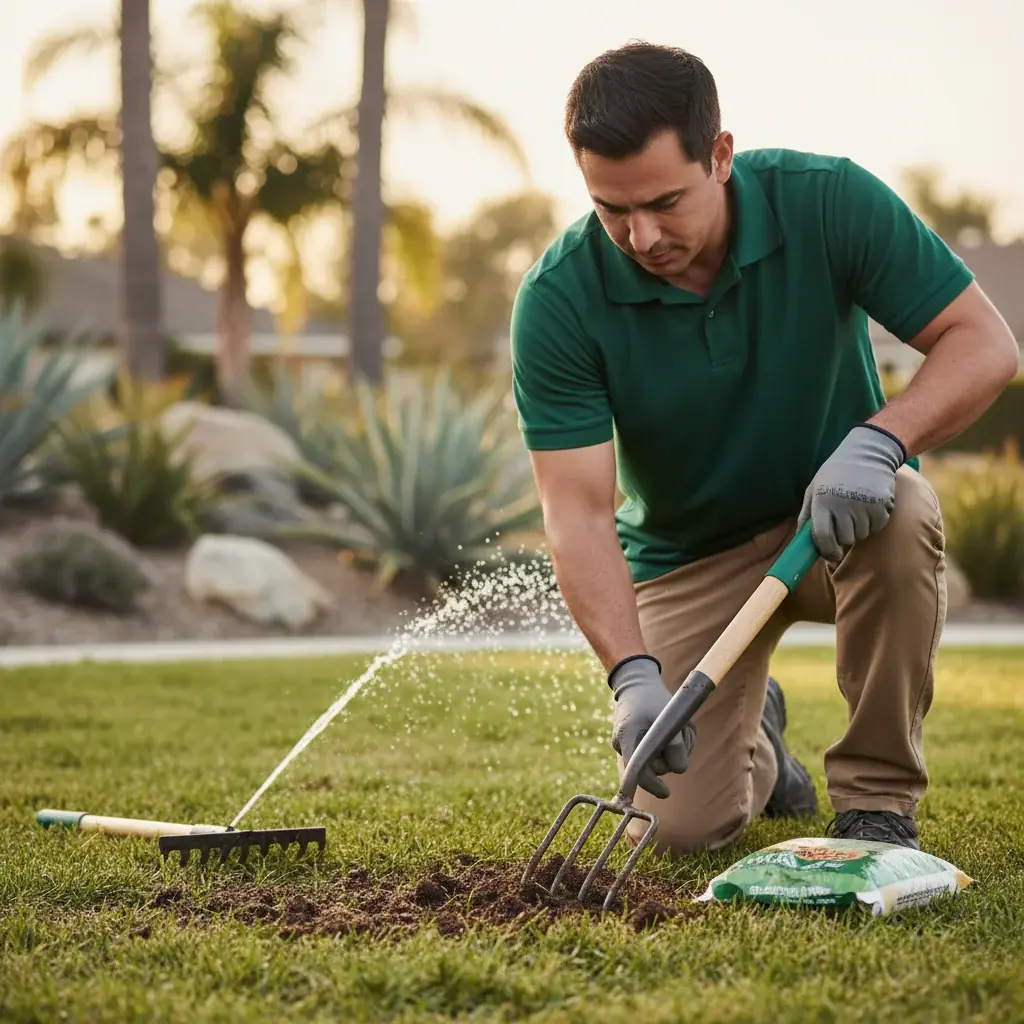
For older lawns showing real heat stress, a heavier seasonal visit is often the next question that includes core aeration to break up compacted clay soil (common in this part of East County) and an irrigation check to catch dry zones before they turn into dead patches. If the lawn is far enough gone, converting to a heat-tolerant warm-season grass like hybrid Bermuda, rather than continuing to fight fescue through Santee summers, is often the more honest comparison than ongoing rescue treatments.
Lawn care cost in Santee
Pricing is set by the independent contractor after a walkthrough. Bloom Pro SD does not publish local rate sheets. Ask for a written scope that names turf area, visit frequency, slope, access, and which add-ons are included.
| Quote field | Why it changes the number |
|---|---|
| Measured turf and bed area | Sets mow and trim time |
| Weekly vs bi-weekly | Changes monthly total and how tall the grass is at each visit |
| Slope, gates, and obstacles | Adds labor beyond a flat rectangle |
| Edging, string trim, blow-off, haul-off | Often the difference between two similar totals |
| Fertilization, aeration, weed control | Separate programs, not a free weekly extra |
| Irrigation diagnosis | Broken heads and coverage gaps are extra work |
For county-wide comparison questions, see our lawn care cost guide. A neglected lawn may need a separate cleanup before it goes on a route.
Lawns needing rescue treatment for heat stress, or a full irrigation retrofit alongside the mowing, run above these base ranges. For a wider look at pricing patterns across San Diego County, see our 2026 lawn care cost guide.
Common problems on Santee lawns
Heat stress is the dominant issue. Grass takes on a dull, grayish cast and crisps at the tips first, usually in the areas furthest from a sprinkler head or where coverage overlaps poorly. Deep, infrequent early-morning watering beats frequent shallow watering here, since shallow watering keeps roots shallow and more exposed to heat damage.
Compacted clay soil is a close second. Santee’s soil tends to be heavier than coastal sandy soils, and compaction over years of foot and equipment traffic makes it harder for water to reach the root zone at all. Grass on compacted soil can look under-watered even when the irrigation system is running exactly as scheduled, which is why the crews we match you with check compaction before assuming a watering-schedule fix will solve it.
Hard water scale inside sprinkler heads and emitters is worth checking on any Santee lawn with persistent dry spots in the same location season after season. Mineral buildup restricts flow gradually, so a head that worked fine two years ago can be delivering meaningfully less water today without any obvious sign beyond the dry patch itself.
Getting on a Santee route
Call us at (760) 400-6355 and tell us what your lawn looks like right now, including whether it’s original grass from when the home was built or has been replaced since. The pros we match you with will walk the property, check soil compaction and irrigation coverage, and build a plan that’s honest about whether the current turf is worth continuing to maintain or due for a heat-tolerant replacement.
Full service details and booking are on our Santee landscaping page. Nearby, our El Cajon lawn care guide covers a similar East County heat profile.
Frequently asked questions
How much does lawn care cost in Santee? There is no reliable neighborhood average. Recurring service is quoted after the contractor measures turf area and lists what each visit includes. Weekly and bi-weekly are different products. Add-ons such as fertilization, aeration, and irrigation repair are priced separately.
Why does my Santee lawn struggle every summer even though it’s watered? Original fescue lawns in this part of East County often can’t handle inland summer heat regardless of watering, since fescue is a cool-season grass. Compacted clay soil and hard water buildup in sprinkler heads can compound the problem even on a properly scheduled system.
Is it worth replacing an old Santee lawn instead of continuing to maintain it? Often, yes, if the lawn is original from when the home was built in the 1990s or 2000s and consistently struggles through summer. Converting to a heat-tolerant warm-season grass like hybrid Bermuda usually costs less over time than repeated rescue treatments on a grass type that isn’t suited to the heat.
Does hard water from Padre Dam affect my lawn? It can contribute to mineral scale inside sprinkler heads and emitters over time, which gradually reduces water delivery to specific zones even when the system runs on schedule. Persistent dry spots in the same location season after season are worth checking for this.
When to call us
Santee lawns need a plan that accounts for real heat, compacted soil, and turf that may be past its useful life. Call (760) 400-6355 to get matched. The independent professional quotes after seeing the lawn.