A shady La Jolla side yard and a full-sun El Cajon front lawn are not the same grass job. Tall fescue is a cool-season turf that can hold color through our mild winters, then it has to live through inland heat and local watering rules. The fit is about your block, your shade, and how you use the yard.
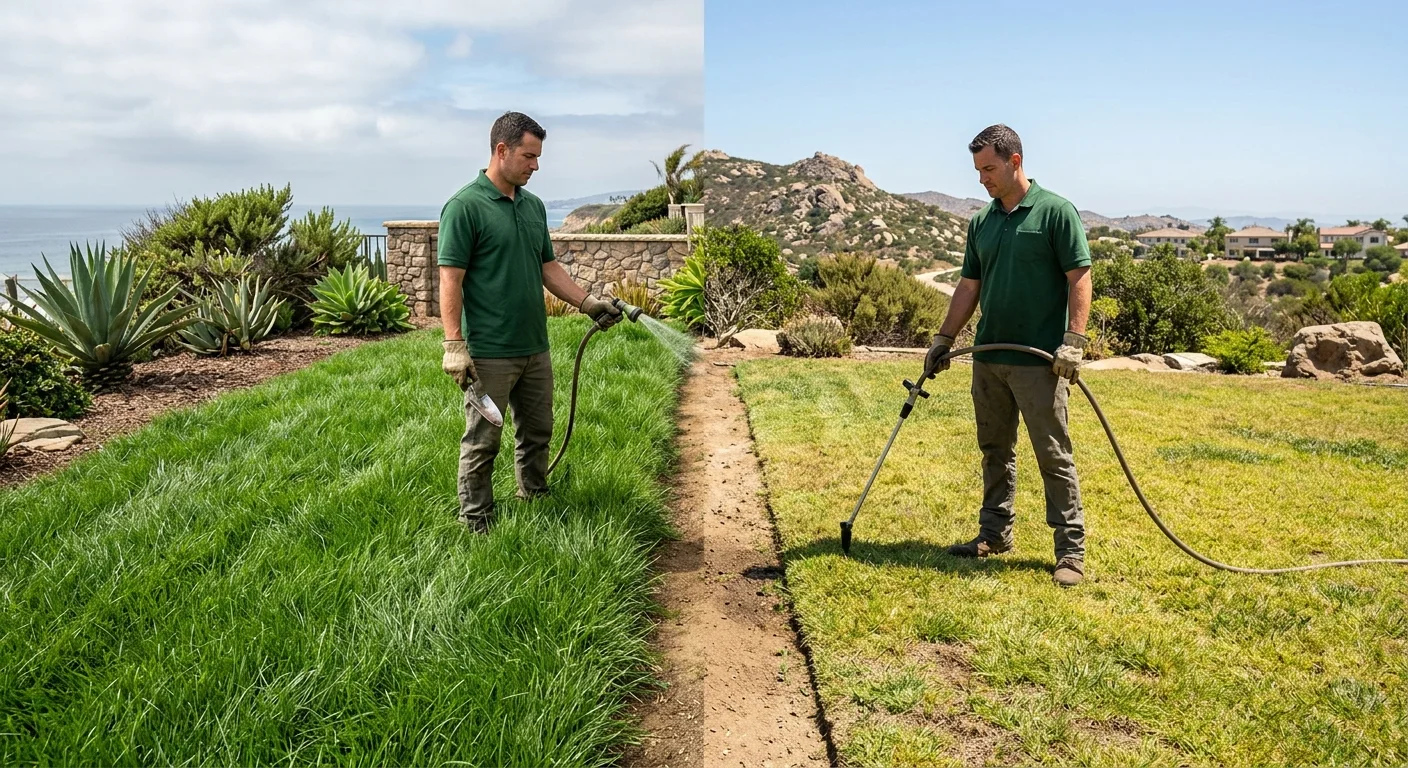
How does tall fescue differ from warm-season grasses?
Tall fescue (Festuca arundinacea) is a cool-season grass. It grows hardest in spring and fall. Warm-season grasses such as bermudagrass, zoysia, and kikuyu grow hardest in summer heat. That split is the whole San Diego decision.
The University of California Statewide IPM Program’s Healthy Lawns guide describes tall fescue as well adapted to sun or partial shade. A dense stand looks uniform, with a moderate to coarse blade. Newer turf-type and dwarf turf-type varieties are finer and shorter than the old pasture types. UC also calls tall fescue the most common lawn grass in California, and notes that it stays green in cool, not severe, winter weather.
It is a bunch grass. It tillers, but it does not creep the way bermuda or Kentucky bluegrass do. UC is plain about the result: thin spots stay thin until you reseed. That is the trade for a turf that does not run into flower beds.
Water is the other split. UC Master Gardeners of San Diego County report that warm-season grasses need 25% less water than cool-season varieties. Tall fescue can handle heat better than many other cool-season grasses. It is still a cool-season plant. A bermuda or zoysia lawn will usually drink less in a Ramona or Lakeside summer than a fescue lawn of the same size.
For a side-by-side with the county’s main warm-season choice, read fescue vs bermuda in San Diego. For the wider menu, start with best grass types for San Diego lawns.
Kentucky bluegrass comes up in the same search. Bluegrass spreads by rhizomes and can fill small scars. Tall fescue does not. Bluegrass also wants a cooler summer than East County typically gives it. If winter green and shade matter more than self-repair, fescue is the closer cool-season pick. If summer color with less water is the goal, a warm-season grass is the closer pick.
Where do coastal and inland conditions change the fit?
San Diego County is not one climate. Coastal north county, the central city, the South Bay, and inland valleys treat tall fescue differently.
Along Encinitas, Carlsbad, Solana Beach, and La Jolla, marine layer keeps summer highs in check. Tall fescue’s cool-season growth lines up with that air. Winter color is the easy win. You still have to water in dry stretches. You still have to mow on the plant’s schedule. The heat load is simply lower than it is 20 miles inland.
Move to El Cajon, Santee, Lakeside, Escondido, or Ramona and the same grass meets a different summer. Pavement, canyon slopes, and inland valleys push afternoon heat. UC says tall fescue tolerates warm summers relative to other cool-season grasses. That is not the same as thriving on a west-facing Lakeside lot with reflected heat off stucco. Inland fescue that looks rich in March can thin, brown, or invite weeds by August if irrigation and mowing fall behind.
South Bay lots in Chula Vista and National City sit warmer than the north coast, with less marine cover on many streets. Central-city yards in North Park, City Heights, and Clairemont mix both worlds: canyon shade on one side, full west sun on the other. One species across that whole lot is often the mistake. A fescue mix in the shade and a warm-season grass in the open, or a smaller lawn plus planting beds, can match the site better than one seed bag for the whole property.
City of San Diego Public Utilities customers also live under year-round watering rules. Outdoor watering with potable water is allowed only before 10:00 a.m. or after 6:00 p.m. Watering is prohibited during rain and for 48 hours after measurable rain. Irrigation must not run onto sidewalks, streets, or the neighbor’s lot. Other water agencies in the county set their own rules, so confirm yours before you set a timer. EPA WaterSense is a solid check on controller and nozzle efficiency.
Higher East County elevations are a separate case. UC notes tall fescue is not well adapted to high altitudes. If you are in a mountain community, ask a local pro and UC Master Gardeners rather than copying a coastal recipe.
How do sun, shade, and foot traffic affect the choice?
Sun is where many San Diego fescue lawns are asked to do the wrong job. UC places tall fescue in sun or partial shade. It is one of the better cool-season choices under eucalyptus, coral trees, and two-story shade. Bermudagrass wants open sun and thins hard under a dense canopy. If the only green you can keep is on the north side of the house, tall fescue is often the grass that belongs there.
Full west sun on inland stucco is the opposite test. Reflected heat and long afternoons push a cool-season stand toward stress. That is where bermuda, zoysia, or a smaller lawn with drought-tolerant planting usually fits better.
Traffic is moderate, not unlimited. UC describes tall fescue as tolerant of moderate use and of less frequent mowing than some turf. Kids, dogs, and a side-yard path will wear a bunch grass into bare soil. Those scars do not knit themselves shut. Plan on overseeding, or pick a spreading warm-season grass for the play strip and keep fescue where feet are lighter.
Mowing follows the plant, not a calendar slogan. UC IPM’s one-third rule is the verified line: do not take off more than one-third of the blade in one pass. Removing more stresses the plant and drains root reserves. A specific San Diego mowing height for tall fescue is not in our verified ledger. Confirm height with the UC Guide to Healthy Lawns and the crew that will cut it.
Feeding is seasonal, not weekly. UC IPM treats spring and fall as the main feeding seasons for cool-season lawns on the Southern California coast and in inland valleys, and it tells you to ease off in high summer heat. Nitrogen is the nutrient turf uses regularly. Phosphorus and potassium belong on a soil test, not on a guess. Product labels govern rate and re-entry. There is no universal NPK blend, and no verified “safe for pets the same afternoon” claim in our ledger.
Ongoing weekly lawn maintenance is how a fescue stand stays dense enough to crowd weeds. Height, irrigation, and clippings matter more than a product name on a bag.
When does repair, overseeding, or replacement make sense?
Because tall fescue is a bunch grass, repair is usually seed or sod in the thin spots, not waiting for runners. UC is direct: open areas need to be reseeded. A few brown patches after a hot week can be irrigation, grubs, or dog damage. A lawn that is 40% dirt with clumps of coarse fescue is past spot repair.
Overseeding makes sense when the stand is still mostly fescue, the soil is not compacted into brick, and you can keep new seed moist through establishment. Fall lines up with cool-season growth. A locked San Diego seeding date, pounds per thousand square feet, and germination-day count are not in our verified ledger. Do not copy Midwest or Georgia calendars onto a Chula Vista lot. Ask UC Master Gardeners of San Diego County, then have the matched contractor set the rate for your seed and soil.
Sod makes sense when you want a finished surface, when seed would wash on a slope, or when the old stand is mixed with bermuda you cannot rake out. The crews we send for sod installation handle grading, soil contact, and the first watering plan. They confirm the price with you before work starts. We do not sell sod, own a yard, or install it ourselves.
Replacement makes sense when the lawn is the wrong species for the exposure. Inland full sun with a water bill you cannot live with is a species problem, not a fertilizer problem. If you pull the turf, SoCal Water$mart’s residential turf replacement program pays $2.00 per square foot of removed turf, up to 5,000 square feet of converted yard per year, with local top-ups that change by agency and funding. Synthetic turf does not qualify. Projects need at least three plants per 100 square feet, a stormwater feature, permeable surfaces, and a switch away from overhead spray, and you need approval before the grass comes out. Check your address on SoCal Water$mart.
Disease talk on national fescue pages often names brown patch. That is not a verified San Diego diagnosis in our ledger. UC’s species page describes good disease resistance when the stand is dense. Overwater, summer nitrogen, and dull blades still make any lawn sick. If patches spread, have a pro look at irrigation first, then pests, then disease. Guessing a fungicide from a photo wastes a season.
What should you share before requesting a contractor match?
We are a referral service. We take the job details and match you with a licensed, independent landscaping pro. You contract with that pro and pay them directly. The more site-specific your notes, the better the match.
Share the city and the exposure. “Coastal Encinitas, north side, two-story shade” is useful. “San Diego lawn” is not. Note whether the lot is City of San Diego water service or another agency, because watering days and hours are not county-wide.
Share how the lawn is used. Dog runs, kids, a putting strip, or a front yard you only look at will point the pro toward repair, overseed, sod, or a smaller lawn. Photos of thin spots, slopes, and the irrigation box save a wasted visit.
Share what is in the ground now if you know it. Coarse clumps with a wide blade often mean older tall fescue. Fine, even turf may already be a turf-type blend. A lawn that goes straw-colored in winter is likely bermuda. Mixed stands are common, and they change the repair plan.
Share HOA rules and any plan to remove turf for rebate. The matched contractor pulls permits when a job needs them. We do not pull permits, hold a C-27, or keep equipment. You can verify a contractor’s license on the CSLB license check.
What are the downsides of tall fescue?
It drinks more than warm-season grass. UC Master Gardeners of San Diego County report that warm-season grasses need 25% less water than cool-season varieties. It will not fill bare spots on its own. Inland summer heat can thin it. You will reseed to keep density. Those are the real costs of winter color and shade tolerance.
Is tall fescue a good lawn in San Diego?
It is a good lawn on coastal and canyon lots with some shade, moderate traffic, and a watering plan you can keep. It is a poor lawn on a full-sun inland pad if the goal is low water and summer toughness. Site first, species second.
Which is better, Kentucky bluegrass or tall fescue?
For most San Diego yards, tall fescue is the more realistic cool-season choice. Bluegrass spreads and can hide scars. It also wants a cooler summer than inland valleys usually provide. Fescue takes heat better among cool-season grasses and handles partial shade. Neither matches bermuda on summer water.
What are the common problems with tall fescue?
Thin, clumpy turf from skipped overseeding. Summer fade inland. Weeds in the gaps. Scalping when someone cuts too much blade at once. Runoff when sprinklers ignore the City’s timing and runoff rules. Most of those are culture, not a cursed variety.
When to call us
Call when the stand is too thin to mow into shape, when you want fescue sod or seed placed correctly, or when you are choosing between repair and a different grass. Call us at (760) 400-6355 and we’ll match you with a licensed local pro.