Lakeside sits east of Santee along Highway 67, and the lots out here don’t look like the rest of San Diego County. Multi-acre ranch properties, horse setups along the Eucalyptus Hills and Wildcat Canyon Road corridors, and manufactured housing parks mixed in with larger custom homes. A lawn out here isn’t a small front-yard rectangle. It’s often a real patch of turf on a property that also has a barn, a well, or a septic tank, and that changes what lawn care actually means. Bloom Pro SD matches Lakeside homeowners with licensed independent landscapers. Here is what recurring lawn service looks like on rural East County lots, and what tends to go wrong.
Why Lakeside lawns need different care than the coast
Three things separate Lakeside from a coastal San Diego lawn: heat, water source, and lot size.
Summer heat and dry Santa Ana wind events pull moisture out of turf fast. A lawn that would coast through a mild coastal summer on standard watering can brown out here if the irrigation schedule doesn’t account for the heat load. Warm-season grasses like Bermuda and hybrid Bermuda hold up far better than cool-season fescue, which struggles to survive an inland Lakeside summer at all.
Water source matters more here than almost anywhere else in the county. A lot of rural Lakeside properties run on private wells rather than municipal water, and well water often carries more dissolved minerals. That hard water leaves visible white mineral deposits on hardscape and can affect soil chemistry over years of irrigation. If your lawn has been getting patchy in the same spots season after season, mineral buildup around sprinkler heads or in the soil is worth ruling out before assuming it’s a watering problem.
Lot size changes the math on service too. A quarter-acre coastal lawn and a full-acre rural Lakeside lawn are not the same job, even at the same per-visit rate structure, because mow time, trimming around fence lines and outbuildings, and blowdown all scale with square footage. For background on how lot size and neighborhood affect pricing across the county, see our San Diego landscaping cost by neighborhood guide.
What a recurring Lakeside lawn care visit includes
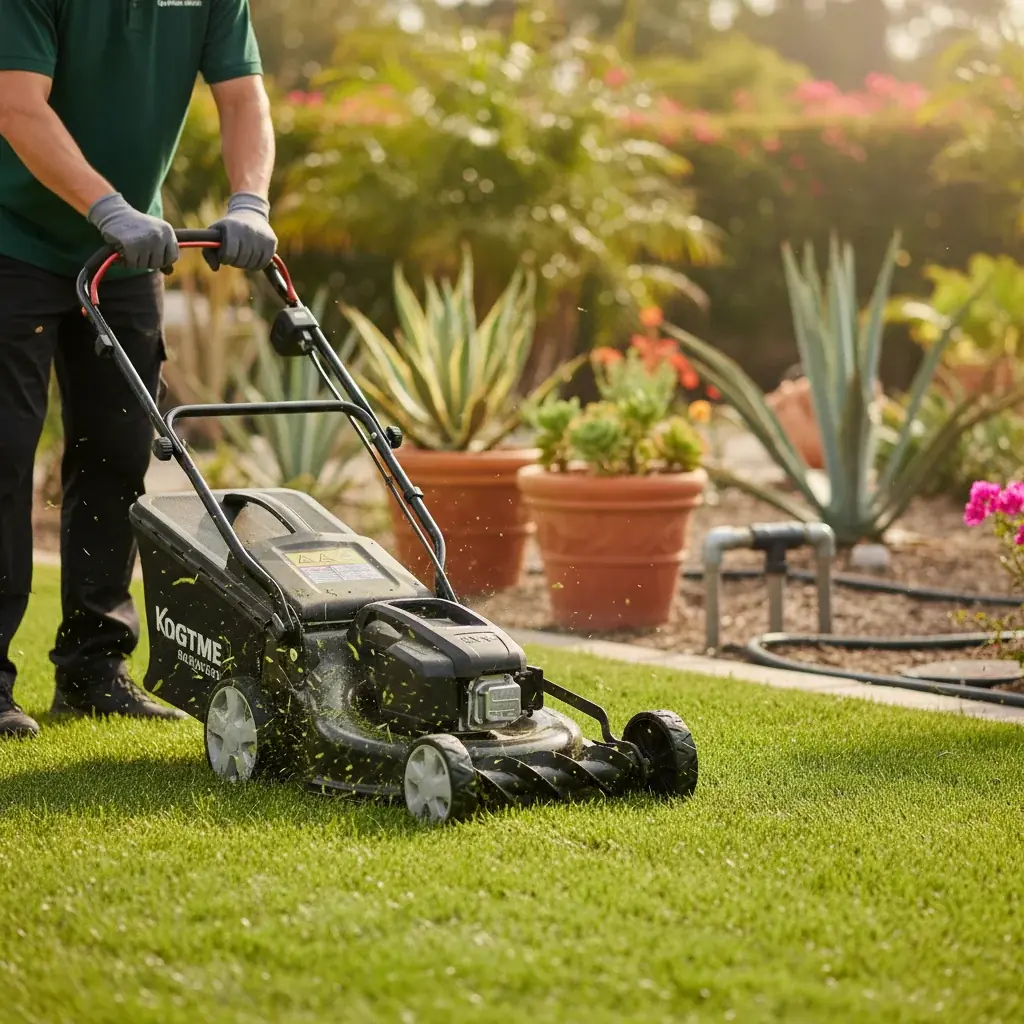
Our lawn maintenance route in Lakeside covers the same core scope everywhere in the county, adjusted for the property. Every visit includes mowing at the right height for your grass type and the season, edging along fence lines, driveways, and beds, line trimming around trees, posts, and any equestrian fencing, and blowdown so clippings don’t end up in a pool, on a driveway, or against a barn wall.
Because rural Lakeside lots often border open space, brush clearance and defensible-space awareness come up more than they would in a dense suburban tract. The crew flags overgrown vegetation near structures during the regular visit rather than waiting for a separate fire-season inspection. If your property backs up to canyon or open land, ask us to fold basic perimeter cleanup into the recurring route.
Lawn care cost in Lakeside
Pricing on rural lots depends heavily on total turf square footage, how much of the property is lawn versus native or unmaintained land, and how far apart obstacles like fencing, gates, and outbuildings sit. Pricing is set by the independent contractor after a walkthrough. Bloom Pro SD does not publish local rate sheets. Ask for a written scope that names turf area, visit frequency, slope, access, and which add-ons are included.
| Quote field | Why it changes the number |
|---|---|
| Measured turf and bed area | Sets mow and trim time |
| Weekly vs bi-weekly | Changes monthly total and how tall the grass is at each visit |
| Slope, gates, and obstacles | Adds labor beyond a flat rectangle |
| Edging, string trim, blow-off, haul-off | Often the difference between two similar totals |
| Fertilization, aeration, weed control | Separate programs, not a free weekly extra |
| Irrigation diagnosis | Broken heads and coverage gaps are extra work |
For county-wide comparison questions, see our lawn care cost guide. A neglected lawn may need a separate cleanup before it goes on a route.
Larger rural parcels with an acre or more of maintained turf, heavy fencing to trim around, or equestrian layout take more mow and trim time. If your lawn has gone unmaintained for a season or more, expect a separate one-time cleanup charge before it goes on a regular route. Our 2026 San Diego lawn care cost guide breaks down what drives pricing county-wide.
Common lawn problems we see in Lakeside
Heat stress leads the list here more than almost anywhere in the county. Grass takes on a dull, gray-green look and crisps at the edges where sprinkler coverage doesn’t fully reach, especially on the outer edges of larger lots where irrigation runs are longest. Deep, infrequent watering during early morning hours beats frequent shallow watering, since shallow watering encourages roots to stay near the surface where heat damage hits hardest.
Hard water spotting on hardscape and mineral scale inside sprinkler heads is a recurring inland-well issue. It shows up as chalky white residue on driveways and patios, and over time it can clog smaller emitter openings on drip systems. Regular irrigation checks catch this before it turns into dead zones.
Compacted soil is common on properties where trucks, trailers, or horse trailers regularly cross the same ground near the lawn edge. Compacted ground sheds water instead of absorbing it, which starves grass roots even when the sprinklers are running on schedule. Aeration opens the soil back up and is worth scheduling annually on properties with regular vehicle or foot traffic.
Getting on a Lakeside route
Call us at (760) 400-6355 and describe your property, roughly how much is maintained turf versus native land, and whether you’re on well or municipal water. The pros we match you with will walk the site, check your grass type, soil, and irrigation coverage, and build a plan sized to the actual property rather than a standard suburban template.
From there the contractor places you on a route if they have one that covers your area. Visit day is theirs to confirm. You can see full service details and request a quote on our Lakeside landscaping page. Nearby, our El Cajon lawn care guide covers a similar inland heat profile if you’re comparing notes across the area.
Frequently asked questions
How much does lawn care cost in Lakeside? There is no reliable neighborhood average. Recurring service is quoted after the contractor measures turf area and lists what each visit includes. Weekly and bi-weekly are different products. Add-ons such as fertilization, aeration, and irrigation repair are priced separately.
Does well water affect my lawn in Lakeside? It can. Well water in this part of East County often carries more dissolved minerals than municipal supply, which can leave hard water deposits on hardscape and, over years, affect soil chemistry near frequently irrigated zones. If patches keep browning in the same spots, ask us to check for mineral buildup around the sprinkler heads.
What grass type handles Lakeside summers best? Warm-season grasses like Bermuda and hybrid Bermuda hold up far better than cool-season fescue once inland summer heat sets in. Bermuda goes dormant and browns in winter but carries the long, hot growing season on much less water than fescue would need to survive.
Do you handle brush clearance near the lawn on rural lots? The crews we match you with flag overgrown vegetation near structures and fence lines as part of the regular maintenance visit on properties bordering open space. For a full defensible-space project beyond what fits in a routine mow, ask about scheduling a dedicated cleanup.
When to call us
Lakeside lawns take more heat, more well-water mineral load, and more square footage than a typical coastal yard, and the care plan needs to reflect that. Call (760) 400-6355 to get matched. The independent professional quotes the work.