Kikuyu and St. Augustine are both warm-season grasses. Which one fits depends on sun, traffic, invasiveness, and the named cultivar. Bloom Pro SD matches homeowners with licensed independent contractors. We do not rank a county-wide winner or publish sod prices.
Confirm shade hours, mowing height, and planting method on the sod tag. Treat invasiveness as a site-management issue: kikuyu can spread aggressively. Do not use unpublished weekly water inches or installed price bands from this page.
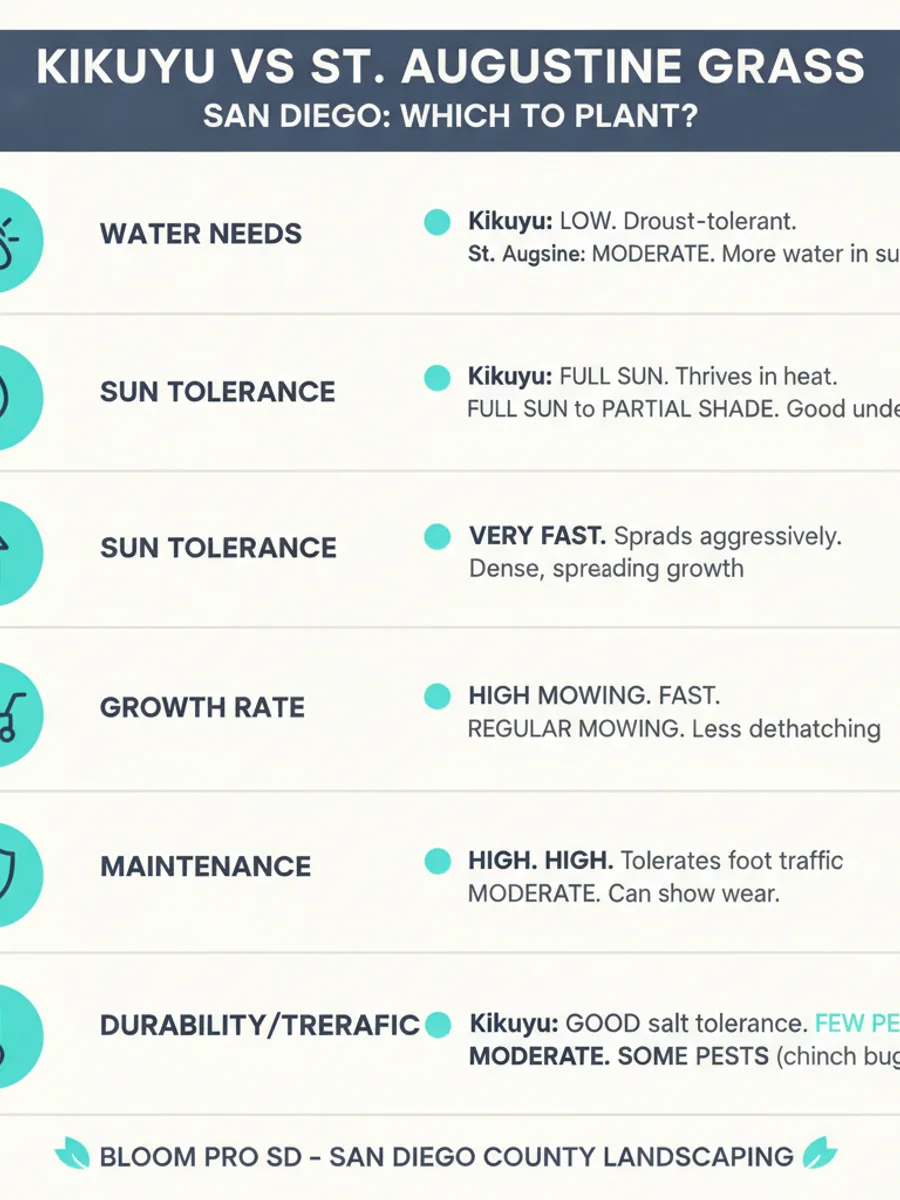
Side-by-side comparison for San Diego conditions
| Factor | What to verify |
|---|---|
| Season type | Both are warm-season. Confirm winter color on the cultivar sheet. |
| Shade | Ask the grower. Do not treat 4-hour or 6-hour sun as a law. |
| Water | Follow the cultivar and your irrigation audit, not a weekly inch recipe. |
| Traffic | Ask how the named grass repairs. |
| Invasiveness | Kikuyu can be aggressive. Plan edges and neighbors. |
| Sod cost | Compare named product quotes. |
Shade is where St. Augustine has no competition
This is the clearest difference between the two grasses. Kikuyu needs full sun, at least six hours of direct sunlight daily, to stay dense and healthy. Give it partial shade and it thins out, turns patchy, and loses its signature vigor within a season. St. Augustine, on the other hand, holds a healthy lawn with four to six hours of sun per day. That makes it the practical choice for specific San Diego situations:
- Canyon-rim lots in Tierrasanta, Scripps Ranch, and Mission Valley where late-afternoon shade rolls in early
- North-facing side yards or beds shaded by a block wall or neighboring structure
- Coastal properties in Pacific Beach, Encinitas, or Coronado where marine layer softens light intensity most mornings
- Yards with mature trees, pepper trees, eucalyptus, and large palms that cast moving shade throughout the day
St. Augustine’s broad blades maximize light absorption in lower-light conditions. Its stolon-based spreading habit still fills in bare spots and crowds out weeds even under a canopy that would starve kikuyu.
If your yard gets six or more hours of full sun and you’re choosing purely on shade, St. Augustine’s advantage disappears. That’s when kikuyu’s other strengths take over.
Water and coastal fit: the inland vs. coastal split
Kikuyu is one of the most water-efficient warm-season grasses in San Diego once its root system establishes, typically around 12 months. Its deep roots access soil moisture between irrigations and it tolerates brief drought without significant damage. San Diego County Water Authority-recommended schedules are generally enough to maintain a healthy kikuyu lawn after year one.
St. Augustine often needs more consistent moisture than a drought-tough warm-season grass. Inland heat can raise that demand. Compare water use from the cultivar sheet and your meter, not from a published top-tier rate on this page.
Coastal properties shift the math. In Pacific Beach, La Jolla, Oceanside, and Carlsbad, marine layer fog reduces evapotranspiration and helps maintain soil moisture. St. Augustine’s water needs are far more manageable in those microclimates, and the added humidity suits its tropical origins. Kikuyu still performs well in coastal areas, but its water advantage narrows when the climate is already doing some of the irrigation work.
Foot traffic, invasiveness, and maintenance
Foot traffic: Kikuyu wins here by a clear margin. Its combination of above-ground stolons and underground rhizomes lets it repair worn paths, divot damage, and bare patches from dogs or kids faster than nearly any warm-season grass. San Diego parks and sports fields use kikuyu for exactly this reason. St. Augustine is solid for active yards, it spreads via stolons and self-repairs well, but it doesn’t match kikuyu’s recovery speed under concentrated, repeated impact.
Invasiveness: Both grasses are aggressive spreaders, and that’s a management consideration for either choice. Kikuyu is more invasive: its rhizome network spreads underground into flower beds, cracks in pavement, and adjacent planted areas in ways that are harder to contain. Steel edging every two to four weeks is non-negotiable for a kikuyu lawn bordered by planting beds. St. Augustine spreads only through above-ground stolons, which are easier to spot and trim back before they cross a border.
Mowing: St. Augustine is mowed higher, typically 2 to 4 inches, which means less frequent scalping risk but more clippings per session. Kikuyu is mowed shorter at 1 to 2 inches and grows faster during peak season, so it needs more frequent mowing in spring and summer. Both grasses benefit from a consistent lawn maintenance schedule during the growing season.
Install cost: Local supply and haul change the material line. Ask the independent professional to price both sods on the same drawing. See the sod installation cost guide for San Diego.
Which grass fits your San Diego yard
Pick kikuyu when:
- Your yard gets six or more hours of full sun daily
- You have kids, dogs, or high foot-traffic areas that need fast recovery
- You’re inland (Escondido, El Cajon, Santee, Poway) where summer heat favors tough warm-season grass
- Water efficiency matters and your yard has good sun exposure
- You want a lower material cost for a large installation
Pick St. Augustine when:
- Your yard gets fewer than six hours of direct sun daily
- You’re in a coastal microclimate where marine layer humidity eases water demands
- Shade from trees, structures, or canyon walls rules out full-sun grasses
- You want a broader blade with a softer, tropical look
- Invasive spread into planting beds is a bigger concern than traffic recovery
For more options in the same category, the kikuyu vs. bermuda comparison covers another popular full-sun pairing. If you’re also weighing a cool-season option for a shaded yard, the St. Augustine vs. fescue guide has the full breakdown. The best grass types for San Diego lawns post covers all major options in one place.
Frequently asked questions
Is kikuyu or St. Augustine better for San Diego?
Kikuyu is the better default choice for most San Diego full-sun yards. It uses less water once established, handles foot traffic better, and costs less to install. St. Augustine is the right call when your yard has significant shade, less than six hours of direct sun daily, or when you’re in a coastal microclimate where its higher water needs are offset by marine-layer humidity.
Which grass is better for shade in San Diego?
St. Augustine is better for shade. It maintains a healthy, dense lawn with four to six hours of sun per day, while kikuyu needs at least six hours and thins out significantly in partial shade. For San Diego yards with large tree canopies, canyon-facing lots, or north-facing exposures, St. Augustine is the practical choice.
Which uses less water, kikuyu or St. Augustine?
Kikuyu uses less water. Once established (around 12 months), its root system accesses soil moisture between irrigations effectively, and it tolerates brief dry periods without visible stress. St. Augustine often needs more frequent summer irrigation than kikuyu once both are established. Confirm inches and days with the serving water agency and a soil-moisture check, not a countywide weekly number.
Which grass is more invasive?
Kikuyu is more invasive. It spreads through both above-ground stolons and underground rhizomes, which means it can move into flower beds, hardscape cracks, and adjacent areas in ways that are harder to detect and stop. St. Augustine spreads only via above-ground stolons, which are easier to spot and contain with routine edging. Both require consistent edging to stay in bounds.
Can you mix kikuyu and St. Augustine in the same yard?
You can, but it doesn’t work well long-term. Kikuyu is aggressive enough to crowd out St. Augustine in the areas it favors, particularly in full sun. The two grasses also have different mowing heights and watering schedules that conflict in a shared lawn. A cleaner approach is to use St. Augustine in shaded sections and kikuyu in sunny high-traffic areas, separated by a hardscape edge or concrete mow border.
Which costs more to install in San Diego?
St. Augustine sod is often quoted differently from kikuyu. Compare named product prices and labor as separate lines. Do not use unpublished per-square-foot San Diego bands from this page.
When to call us
Choosing the right grass is the first step, getting the site prep and installation right is what determines whether it thrives. The crews we match you with handle both for San Diego homeowners, from grading and soil amendment through sod laying and the first irrigation calibration. Call us at (760) 400-6355 to get matched. The independent professional quotes the work.