There is no single best groundcover for every San Diego slope. Plant choice depends on grade, soil, exposure, fire-authority rules, irrigation, and whether the area is a turf-rebate project. Bloom Pro SD matches homeowners with licensed independent landscapers. We do not engineer slopes or guarantee erosion control.
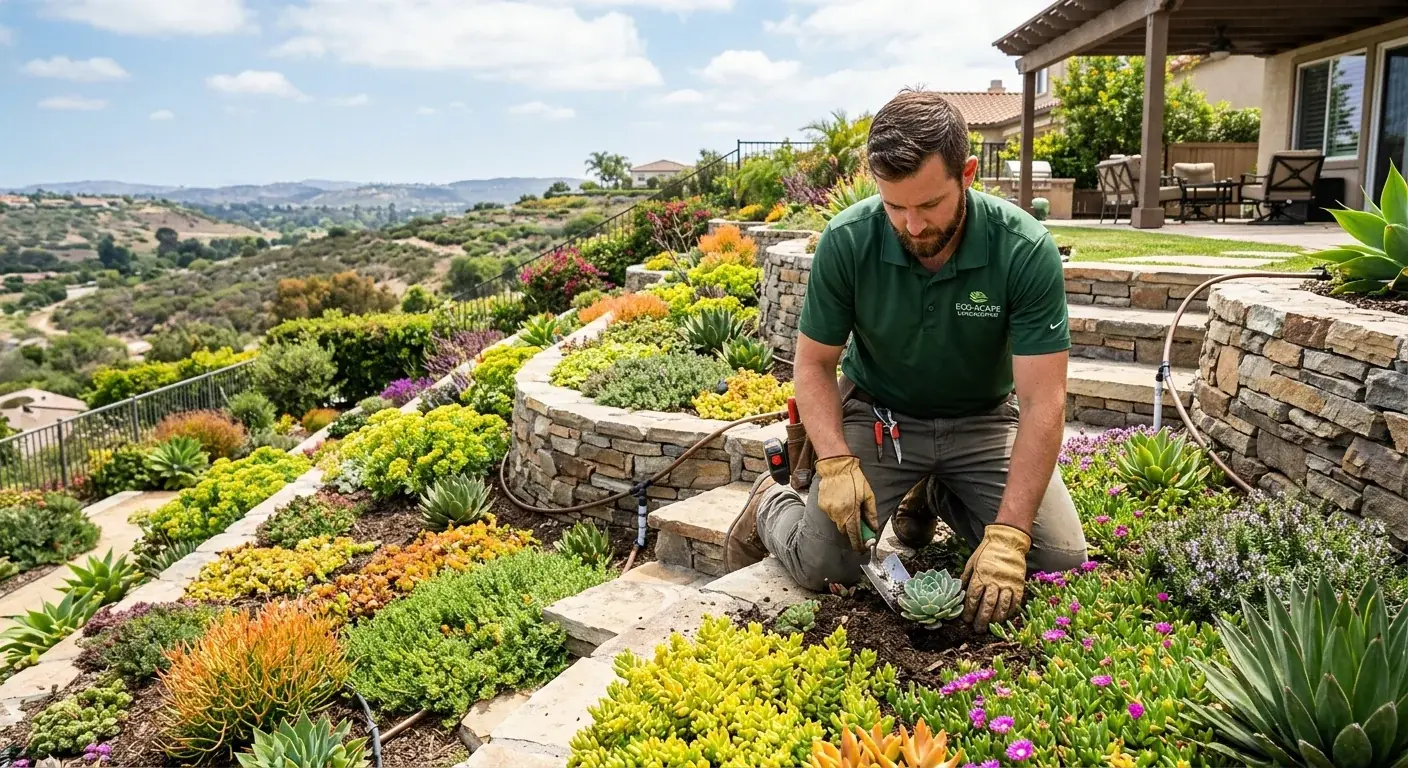
Candidate plants to verify, not a ranked winner list
Homeowners often compare coyote brush (Baccharis), trailing rosemary, ceanothus, trailing lantana, ice plant, senecio, creeping thyme, and dymondia. Treat that list as a starting set. Confirm species, cultivar, mature size, water, and invasiveness on Calscape or with a nursery tag before you buy.
Do not use a blog table of spread rates, root depths, or “erosion ratings.” Those numbers are not in this site’s retained horticultural sources. A contractor or designer should match plants to the actual slope after seeing drainage, access, and any required engineering.
Ice plant and fire risk. Some ice plants hold moisture early, then dry later in the year. Dense mats can be a poor fire-wise choice above a house. CAL FIRE’s Zone 0 materials call for a 5-foot non-combustible buffer, including removing wood mulch next to the structure. Check current CAL FIRE defensible-space rules and your local fire district, not a species ban invented here.
Why slopes are a different job than flat turf
Bare soil and poorly aimed spray on a grade can send water and soil downhill. Groundcover can slow splash and occupy the surface, but it is not a substitute for a retaining wall, drainage design, or a geotechnical recommendation when the slope is structural. Turf on a slope is also hard to water without runoff and hard to mow safely.
For plant palette context, see drought-tolerant plants for San Diego. For walkable lawn alternatives on flatter ground, see ground covers for San Diego lawns.
San Diego-specific checks, not neighborhood recipes
Inland estate slopes. Decomposed granite, heat, and long grades are common on some inland lots. That does not make one cultivar the workhorse of Rancho Santa Fe. Ask for a plant list tied to that soil and irrigation, with spacing from the nursery or designer, not a five-foot-on-center rule from this page.
Coastal slopes. Salt, wind, and sandy soils change the candidate list. Confirm salt and fog tolerance on the plant record. Do not treat “avoid ceanothus on the coast” as a county law.
Fire-hazard zones. In mapped fire hazard severity zones, defensible-space rules apply. Zone 0 is the first 5 feet from the structure in CAL FIRE’s Zone 0 materials. Plant spacing and fuel continuity farther out belong to the current authority diagram. Ice-plant monocultures are a poor fire-wise default.
SoCal Water$mart rebate for a slope conversion
A slope conversion can qualify on the same turf-replacement terms as a flat yard if the area is existing turf and the finished project meets the program. Captured eligibility requires:
- Existing turf. Dead turf or bare dirt does not qualify.
- A reservation before work starts.
- At least 250 square feet of turf removed, or all turf on a site that has less than 250 square feet.
- At least three plants per 100 square feet in the project area.
- A stormwater feature.
- A permeable finished surface. Concrete structures in the measured area can disqualify that area.
- Irrigation converted off overhead spray.
- No synthetic turf.
Confirm current payout and funding in the SoCal Water$mart estimator. Do not budget a copied per-square-foot dollar from this article. The homeowner owns the application. Bloom Pro SD does not file it or promise approval. See drought-tolerant rebates San Diego 2026.
How to plant groundcover on a slope
Ask the installer to follow the plant’s nursery instructions and any erosion-control plan. Common field practices include downhill basins so water does not sheet past the root ball, planting in the rainy season when possible, and keeping mulch off stems. UC Master Gardeners of San Diego County note that the local rainy season is roughly October through April and that natives are often planted then so rainfall can help roots establish, with supplemental water as needed in the first months.
Overhead spray on a slope often runs off. Drip or other low-volume emitters are usually the conversion path on rebate projects. Exact emitter flow and runtime come from the design, not a 30-to-45-minute recipe.
If the grade needs a wall, see retaining wall cost for San Diego slopes. Groundcover does not replace a structural wall.
Combining groundcovers with retaining walls
On a steep, moving slope, a qualified designer or engineer should say whether plants alone are enough. Walls handle retained soil; plants cover the surface between and above them. If you need a drawing first, landscape design is the planning service.
Frequently asked questions
Can you hydroseed groundcovers on a Southern California slope?
Sometimes, if the seed mix, tackifier, and erosion blanket match the slope and the permit or rebate rules. Hydroseeding is not automatically cheaper or faster than containers. See hydroseeding cost in San Diego for the quote fields, not a guarantee it will knit before the first storm.
What’s the best groundcover for a San Diego slope?
None from a blog. Start with natives and Mediterranean plants that Calscape and the nursery document for your exposure, then have the installer confirm irrigation and fire-authority spacing.
What holds soil on a hill better than grass?
Living roots and surface cover can help compared with bare soil, but depth and “better than turf” are site-specific. Do not rely on a 2-to-6-foot root claim from this page.
Are there no-mow lawn alternatives that work on San Diego slopes?
Dymondia and creeping thyme are sometimes used on low grades and paths. Confirm traffic, water, and grade with the grower. Steeper faces usually need a different plant and no expectation of mowing.
What groundcovers can people walk on?
Walkable groundcovers are limited. Paths that get real traffic usually need pavers, steps, or another wearing surface. Confirm the cultivar’s traffic rating before treating it as a lawn.
When is the best time to plant groundcover on a San Diego slope?
UC San Diego County Master Gardeners point to the rainy season for natives. Later planting usually needs more supplemental water. Avoid assuming a soil-surface temperature from this page.
Do drought-tolerant groundcovers qualify for San Diego water rebates?
They can, if you are removing qualifying turf and the finished project meets every current rule, including plant count, permeability, stormwater, and irrigation. Run the address through SoCal Water$mart. A copied dollar times square footage is not your award.
When to call us
If the slope, fire rules, or rebate paperwork make the project more than a plant list, call (760) 400-6355. We will match you with a licensed local pro. You contract with that professional directly.