There is no single best drought-tolerant plant for every San Diego yard. Confirm species on Calscape or a nursery tag. Candidates homeowners often compare include Cleveland sage, ceanothus, agave, dymondia, and penstemon. Those are starting names, not a ranked top five.
Replacing a lawn with a living low-water palette can cut irrigation on that patch because turf is gone. It does not come with a guaranteed bill cut.
Drought-tolerant landscaping in San Diego
Drought-tolerant landscaping here is not a cactus theme park. It is Cleveland sage, Ceanothus, agave, and a groundcover like dymondia on drip, with the turf rebate paperwork done before anything is ripped out. Ecology Artisans-style plant lists wander into chaste tree and mesquite. Start with the five above unless your lot is actually desert-edge East County. For the install scope, see drought-tolerant landscaping.
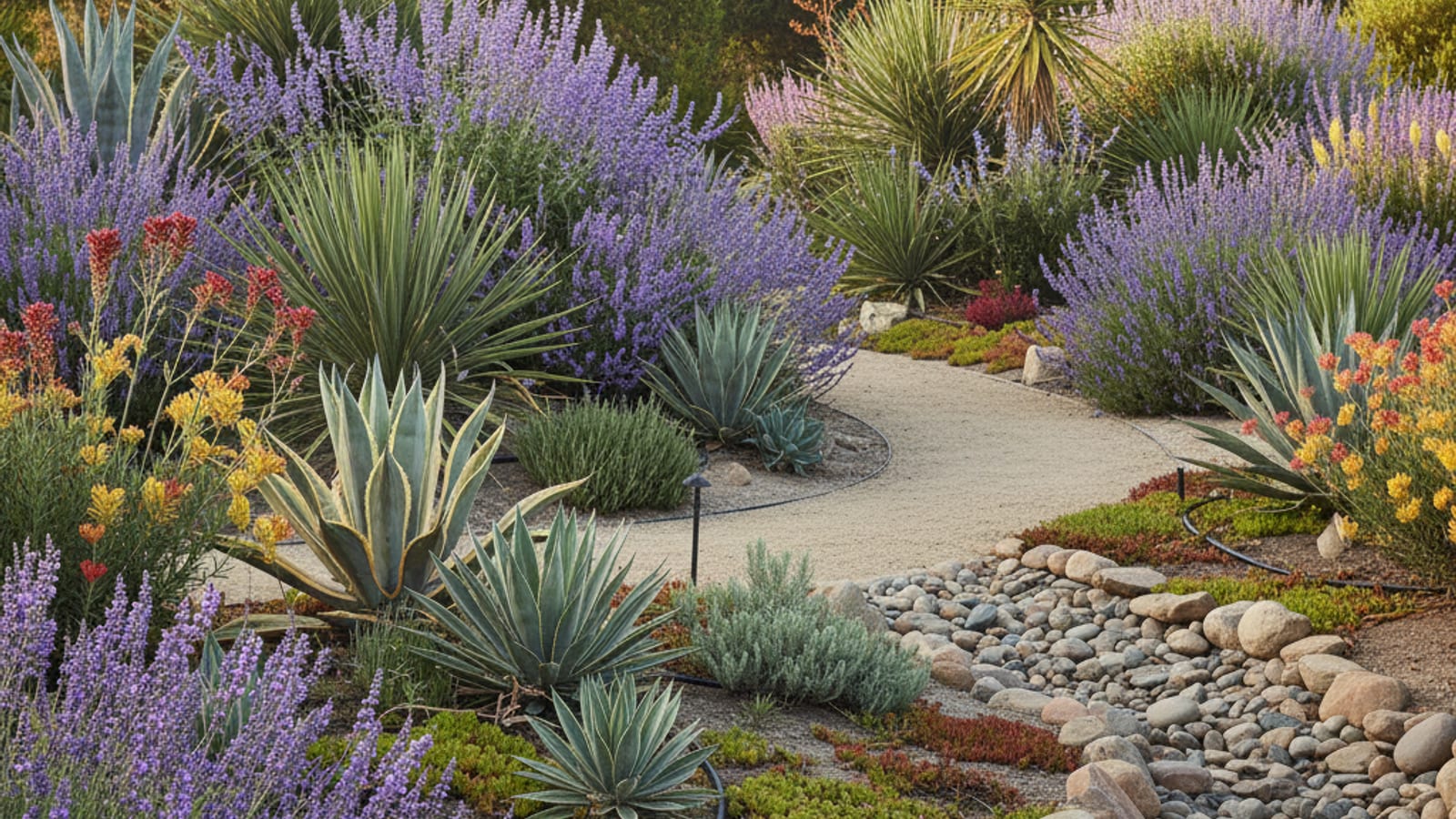
Plant table: top drought-tolerant picks for San Diego
This table covers shrubs, groundcovers, succulents, and natives. “Water need” is supplemental (beyond natural rainfall) after full establishment (roughly year two to three).
| Plant | Type | Water need | Sun | Mature size | Bloom | Best SD zone |
|---|---|---|---|---|---|---|
| Cleveland sage (S. clevelandii) | Native shrub | Very low | Full | 4-6 ft × 4-5 ft | Purple, Apr-Jun | Coastal + inland |
| Ceanothus ‘Concha’ | Native shrub | Very low | Full | 6-8 ft × 8 ft | Blue, Feb-Apr | All zones |
| Ceanothus ‘Dark Star’ | Native shrub | Very low | Full | 4-6 ft × 6 ft | Dark blue, Mar-Apr | Coastal + inland |
| Salvia ‘Bee’s Bliss’ | Native groundcover | Very low | Full/part | 1-2 ft × 6-8 ft | Blue, Mar-May | Coastal |
| Agave attenuata | Succulent | Very low after establishment | Full/part | 3-5 ft × 5 ft | Once, then dies | Coastal + mild inland |
| Agave ‘Blue Glow’ | Succulent | Very low after establishment | Full | 2-3 ft × 3 ft | Accent only | All zones |
| Dymondia margaretae | Groundcover | Very low | Full/part | 1-2 in × spreading | Yellow, summer | Coastal + inland |
| Penstemon heterophyllus | Native perennial | Low | Full | 2-3 ft × 2 ft | Blue-purple, May-Jul | Inland + Rancho SF |
| Westringia fruticosa | Mediterranean shrub | Low | Full | 3-5 ft × 5 ft | White, year-round | Coastal |
| Lavandula stoechas | Mediterranean shrub | Very low | Full | 2-3 ft × 2 ft | Purple, Apr-Jun | All zones |
| Arctostaphylos ‘Howard McMinn’ | Native shrub | Very low | Full | 5-6 ft × 6 ft | White-pink, Jan-Mar | Inland + Rancho SF |
| Desert Museum palo verde | Hybrid tree | Very low after establishment | Full | 25-30 ft | Yellow, Apr-May | Inland + estate |
| Festuca glauca | Ornamental grass | Low | Full/part | 8-12 in × 12 in | Blue foliage | All zones |
| Sedum ‘Angelina’ | Succulent groundcover | Very low | Full | 4-6 in × spreading | Yellow, summer | All zones |
Native and Mediterranean plants such as Cleveland sage, ceanothus, agave attenuata, and dymondia are typical on a turf replacement conversion. The SoCal Water$mart rebate pays a current SoCal Water$mart payout you must confirm in the official estimator, if the project meets the program’s plant-count, stormwater, and irrigation rules. Paperwork sits with the homeowner and the crew on a drought-tolerant landscaping conversion.
Coastal vs. inland zones: what changes
San Diego County spans wildly different growing conditions within 30 miles. What works at the beach fails in the foothills if you don’t account for temperature swings.
Coastal strip (La Jolla, Carlsbad, Del Mar, Encinitas, Imperial Beach): Fog moderation keeps summer highs below 80°F and winters mild. Westringia, ceanothus, and lavender do especially well. Salt tolerance matters, coastal rosemary (Westringia fruticosa) is one of the few shrubs that actively benefits from sea air. Agave attenuata’s soft leaf edges make it the right agave here (no spine tips near foot traffic).
Inland valleys and foothills (El Cajon, Santee, Lakeside, Ramona, Alpine): Temps 10-15°F hotter in summer, occasional freezes below 25°F in winter. Swap agave attenuata for the cold-hardier Agave parryi or Agave weberi. Add more desert-adapted options: Hesperaloe parviflora (red yucca), Larrea tridentata (creosote), Bougainvillea (heat-loving once established). Manzanita (Arctostaphylos spp.) excels here.
Rancho Santa Fe and estate-scale properties: Larger parcels in the 92067 corridor often run the full palette, native oaks as canopy anchors, palo verde mid-story, sages and penstemons as understory. Desert Museum palo verde at 25-30 ft is a dramatic year-round specimen tree that needs very little water after it is established. Even then, a hard drought year can still need a deep soak. For estate-scale groundcover under oaks, Achillea millefolium (yarrow) and native bunch grasses like Stipa pulchra (purple needlegrass) both perform well in the dry shade conditions typical of mature oak groves.
SD-specific shrub detail
For a low-water shrub hedge or screen, Ceanothus ‘Concha’ at 6-8 ft wide is the fastest option, typically full-screening within 18-24 months from a 5-gallon. Westringia is slower but tolerates hard shearing twice a year, which makes it the right call for hedges with precise dimension requirements (HOA lines, entry gates). Pittosporum tobira is technically drought-tolerant once established but uses more water than the others, use it where you need wide salt tolerance and don’t want to sacrifice screening height.
For slopes and erosion control, ceanothus groundcover types, C. griseus horizontalis and C. maritimus, both root deeply and hold steep banks. See our drought-tolerant groundcovers for slopes guide for planting depth and spacing on grades over 20%.
The right companion shrub depends on your existing tree canopy. Under a coast live oak: deep-rooted natives that tolerate summer drought (no irrigation conflict). Under a turf conversion: plants that benefit from the slightly elevated organic matter in former lawn soil, like lavender and manzanita.
Planting timing and water schedule
In San Diego, October through February is the ideal planting window for drought-tolerant plants. You get the entire rainy season (December-March) to establish roots before the first dry summer. Plants put in during May-August face establishment stress in peak heat and typically need 2-3× more supplemental water.
Establishment watering: follow the installer’s written plan for the species they planted. There is no single county minutes-and-days recipe. Over-watering kills more drought-tolerant plants than drought does.
Over-watering kills more drought-tolerant plants than drought does. When in doubt, water less.
What to avoid
Plants that disappoint in SD despite good marketing:
- Hydrangeas, need too much water and consistent shade
- Rhododendrons and azaleas, acid-loving; SD soil is alkaline (pH 7-8)
- Most ferns (except sword fern in deep shade)
- Tropical ornamentals (most fail; bird of paradise occasionally works coastal)
- Kentucky bluegrass / tall fescue in full-sun inland areas, high water demand
Frequently asked questions
Are drought-resistant plants and drought-tolerant plants the same thing?
In everyday use, yes. Drought resistant, drought tolerant, low water and water wise all get used interchangeably for plants that survive San Diego’s long dry season on little or no supplemental irrigation once established. Nurseries and water agencies tend to prefer drought tolerant, so that is the label you will see on rebate paperwork and plant tags, but if you searched for drought-resistant plants you are in the right place. The distinction that actually matters is establishment: almost every plant on this list needs regular water for its first year before it earns the label.
What is the best drought-tolerant plant for San Diego specifically?
Cleveland sage (Salvia clevelandii) is the best single all-rounder for most San Diego yards. It’s a California native that thrives in the county’s alkaline soil, handles both coastal marine layer and inland heat, and blooms purple in spring with a second flush in fall. If you are combining a planting project with a turf rebate, the live program is SoCal Water$mart at the current estimator amount of removed live turf, not an SDCWA plant list.
What are the lowest-water plants for San Diego landscapes?
Agave, cactus, and established native shrubs like ceanothus and manzanita are the lowest-water options, most use zero supplemental irrigation from October through April, and many need only one monthly deep soak in July-September. Dymondia groundcover and sedum varieties come close. The catch is that all of these still need regular irrigation for the first 12-18 months during establishment before they reach true drought tolerance.
What’s the difference between drought-tolerant and native plants in San Diego?
California natives are usually the lowest-water plants for this county, but not every native is a no-water plant, and not every drought-tolerant plant is native. Mediterranean shrubs (lavender, westringia, rosemary) and Australian plants (kangaroo paw) are drought-tolerant but not native. The practical distinction: natives feed local birds and pollinators better. Ceanothus, manzanita, and Cleveland sage are native. Lavender is drought-tolerant but not native.
Do drought-tolerant plants still need irrigation in San Diego?
Yes, for the first 1-3 years, drought tolerance is earned, not immediate. New plants need regular water to establish root systems deep enough to tap soil moisture through the dry season. The establishment window for most shrubs is 12-24 months; for trees and large agaves, up to 36 months. After that, most properly chosen plants in San Diego need only supplemental irrigation during the peak dry period (July-September), ranging from zero (established oaks, cactus) to once-monthly deep soaks (sages, ceanothus). Installing a drip system on a smart controller set to “water budget” mode is the most efficient way to handle establishment without overwatering.
When is the best time to plant drought-tolerant plants in San Diego?
October through February is the ideal planting window. Installing during the rainy season (December-March) lets plants establish roots on natural rainfall, dramatically reducing supplemental irrigation needs. Plants installed in May-August face their first establishment summer in peak heat and typically require 2-3× more hand-watering. If you can only plant in summer, do it early morning, mulch, and keep establishment water on a written plan from the installer. Depth and days belong on that plan, not a remembered recipe.
Which drought-tolerant plants work best in Rancho Santa Fe and larger estate properties?
Desert Museum palo verde, coast live oak, manzanita, and mixed sage understory are the anchors for estate-scale drought-tolerant landscapes in the 92067 corridor. For larger footprints, the design logic shifts from individual plant picks to layered plant communities: canopy trees (oak, palo verde), a mid-story of large shrubs (ceanothus, manzanita, toyon), and a groundcover or bunch-grass understory. Penstemon and yarrow work well as perennial accent layers beneath the larger woody shrubs. For formal areas near structures, westringia hedges take shearing and look intentional from a distance. See our drought-tolerant shrubs guide for estate-hedge comparisons and drought-tolerant trees guide for canopy options by mature size.
What are the best drought-tolerant plants for San Diego?
The reliable performers group into a few categories: succulents and agaves for structure and near-zero water, California natives like toyon, manzanita and ceanothus for habitat value and fire resilience, and Mediterranean-climate plants such as lavender, rosemary and kangaroo paw for colour. Match the pick to your microclimate rather than the county average, because a coastal yard and an inland one support quite different lists.
When to call us
Plant palette is only half the design work. Layout, sun, soil prep, irrigation zoning, and rebate paperwork matter as much as which plants you pick. The crew you get matched with starts with a site walk and a plan sized to the lot.
We cover all of San Diego County. Turf rebate paperwork sits with the homeowner and the crew on a drought-tolerant landscaping conversion. If the planting is part of a bigger redesign, landscape design is the scaled drawing and irrigation zoning. Mulching and bed refresh can be a standalone visit.
For slopes, erosion control, and hillside planting, see our drought-tolerant groundcovers guide. For rebate-specific questions, check our 2026 drought-tolerant rebates guide. For native-specific picks see California native plants for San Diego, and for low-water accents the best succulents for San Diego.
Call us at (760) 400-6355 to get matched. The independent professional quotes the work.