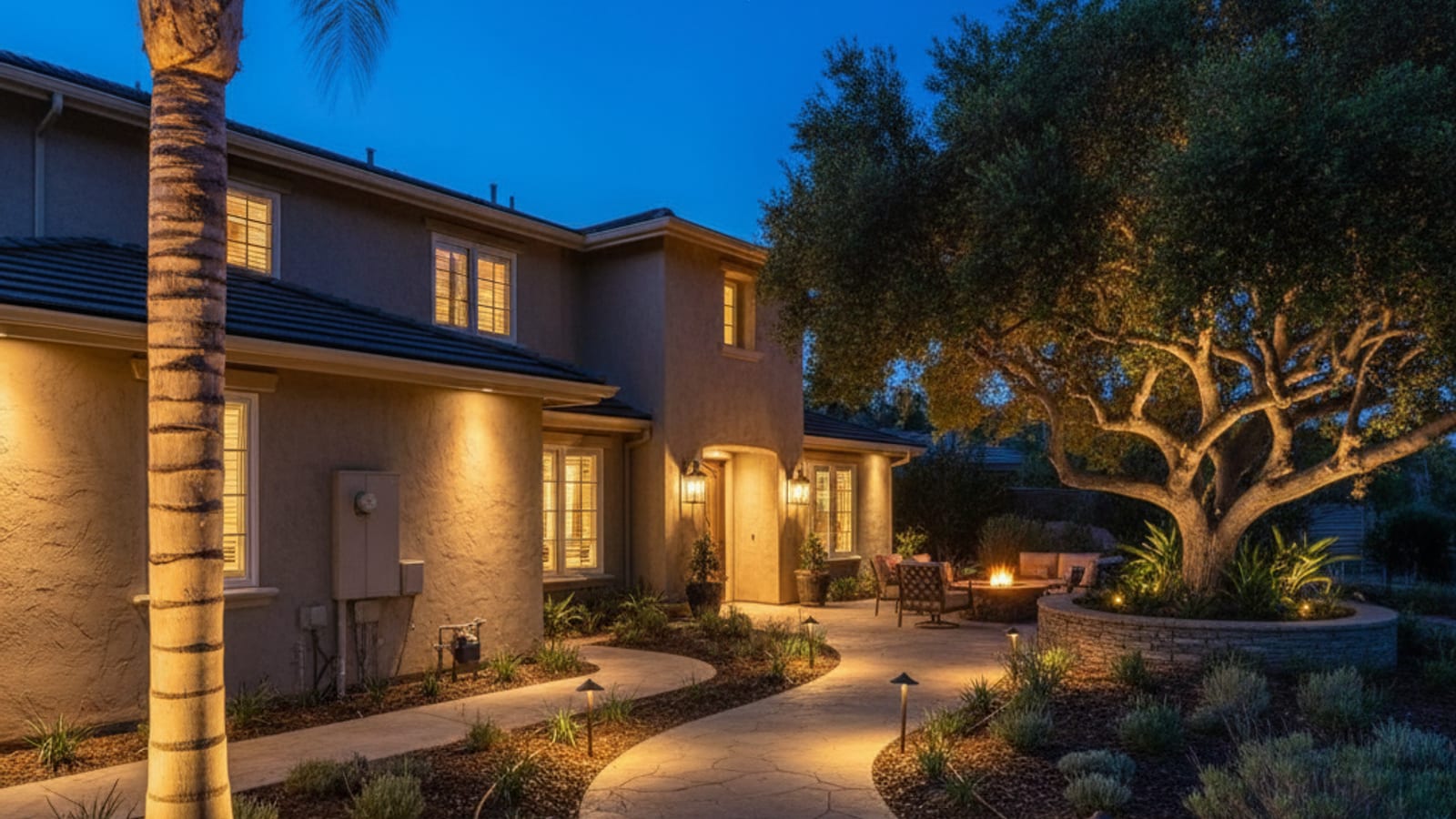
Landscape lighting guide for San Diego homes
A well-designed landscape lighting system does three things: extends outdoor living hours, highlights the landscape investment you’ve already made, and improves safety and security after dark. Done right, it’s one of the highest-ROI exterior upgrades short of a full redesign.
This guide covers what matters for San Diego installs specifically — fixture types, low-voltage vs. line-voltage, the coastal corrosion issue, and realistic costs.
Low-voltage (12V) vs. line-voltage (120V)
Almost every modern residential landscape lighting system is low-voltage. A transformer at the house steps the 120V feed down to 12V, then fixtures run on buried low-voltage wire.
Why low-voltage wins for residential:
- Safer. If a fixture cracks or wire gets nicked, 12V is not a shock hazard. 120V can kill.
- Legal scope for landscape contractors (C-27). We can install 12V systems without an electrician. 120V systems require a C-10 electrical license.
- More efficient with LEDs. Modern LED landscape fixtures run 3-8 watts each. A 200W transformer can drive 30-40 fixtures.
- Easier to modify. Add, move, or swap fixtures without permits or re-wiring.
- No permit required in most SD jurisdictions for the 12V portion.
Line-voltage (120V) systems still exist, primarily in older installs or specific commercial applications. They’re higher output but also higher risk, more expensive to install and repair, and usually overkill for residential.
The transformer itself plugs into an existing 120V GFCI outdoor outlet. If you don’t have one near a good transformer location, an electrician adds one (usually $250-$450 for a single outdoor GFCI). We coordinate with a C-10 for that step if it’s needed.
Fixture types (and what they’re for)
| Fixture type | Best use | Typical wattage |
|---|---|---|
| Path light | Walkway, garden border | 2-4W |
| Up-light (spot) | Specimen trees, architecture | 3-7W |
| Well light | In-ground, washing walls | 3-7W |
| Flood light | Wide wash of a façade | 5-12W |
| Step light | Deck and stair risers | 1-3W |
| Deck light | Post-mounted on patio | 2-4W |
| Under-cap light | Retaining wall caps | 1-2W |
| Hardscape light | Under benches, seats | 1-2W |
| Moonlighting | Downlight from a tree | 3-5W |
Design principle: light the object, not the eye. Good lighting should show off what’s being lit — a textured bark, a stone wall, a palm canopy — without the fixture itself being visible from normal viewing angles. Glare kills an otherwise beautiful installation.
Brass and copper vs. plastic and aluminum
This matters more in SD than anywhere else. Coastal salt air eats aluminum and plastic fixtures within 2-3 years. We’ve replaced entire systems of “builder-grade” aluminum fixtures that lasted 4 years inland before failing, or 2 years coastal.
Good-quality fixtures:
- Solid brass — the standard for quality residential. Develops a patina over 2-3 years but doesn’t corrode through.
- Solid copper — even better corrosion resistance. Higher cost.
- Stainless steel hardware — mounts, stakes, bolts. Never galvanized steel near the ocean.
Bad-quality fixtures:
- Aluminum — corrodes within 2-3 years coastal, 5-7 inland. Don’t buy them.
- Plastic — UV-degrades fast in SD sun. Breaks at the stake within 18 months.
- “Brass-plated” — paint flakes, then the underlying metal corrodes.
Ask any installer what the fixtures are actually made of. If they say “brass-finish” or dodge the question, they’re selling you aluminum with brass paint.
Transformer sizing and zones
A common install mistake: undersized transformer with no headroom. A 300W transformer loaded to 290W has no room to add a fixture later without replacing the transformer.
Sizing rule: run transformers at 70-80% of rated capacity. For a 300W transformer, plan on 210-240W of fixtures. The extra 60-90W is headroom for future additions and for LED driver tolerance.
Common transformer sizes:
- 150W — small systems (8-12 fixtures)
- 300W — standard residential (20-30 fixtures)
- 600W — large residential (40-60 fixtures)
- 900W — estate or multi-zone installs
Zone the system. A smart controller with 2-6 zones gives you independent control of front vs. back, path vs. architectural, dining area vs. pool. App-based scene control lets you set different brightness for “dining,” “everyday,” “late night security.”
The wire problem coastal homes face
Salt air + moisture + poorly insulated connections = corrosion at the splice points. This is where most coastal systems fail first, not at the fixtures themselves.
Standards we install to:
- Wire burial 6” minimum, 10” preferred — protects against lawn edgers and foot traffic
- Silicon-gel-filled waterproof splice connectors at every junction (the yellow gel-filled connectors, not wire nuts with electrical tape)
- UV-resistant UF direct-burial wire rated for outdoor use
- Wire gauge sized for distance — 12-gauge up to 100 feet, 10-gauge beyond that
Systems installed cheaply with wire nuts and electrical tape corrode in 2-3 years coastal. Systems with proper gel splices last 15-20.
Realistic costs (2026 SD)
- Design consultation: $200-$400 (often credited toward install)
- 12-20 fixture front-yard install: $2,400-$4,500
- Full-property install (30-50 fixtures): $6,500-$12,000
- Estate install with smart control, multi-zone, premium brass: $12,000-$25,000
- Existing system repair / transformer replacement: $180-$650
LED bulb life is 40,000-50,000 hours — about 20+ years at 6 hours nightly. The transformer is usually the first thing to fail, and that’s a $200-$400 replacement.
Smart lighting control
A smart transformer (Kichler DMX, Sollos Prizm, WAC Smart, Alliance CS Series) adds:
- Astronomical timer — lights come on at dusk, off at midnight or dawn, auto-adjusting to sunset
- App control — iOS / Android scene programming
- Voice integration — Alexa, Google Home
- Per-zone dimming — 0-100% brightness per zone
- Scheduling — different schedules for weekdays vs. weekends, vacation mode
Adds $180-$350 to the transformer cost. Worth it for anyone who wants to entertain outdoors or doesn’t want to think about lighting after install.
Common design mistakes
Too many path lights. A row of identical path lights every 3 feet looks like runway lighting. Space at 8-12 feet for a natural look, or skip path lighting entirely on short walkways and use down-lights from nearby trees.
No moonlighting. The most elegant lighting effect is a soft downlight from within a tree canopy, creating the effect of moon filtering through leaves. Often skipped because it requires climbing to install fixtures. Worth the effort.
All one color temperature. Mixing 2700K (warm), 3000K (neutral warm), and 4000K (neutral) fixtures looks amateur. Pick one temperature (we default to 2700K warm for most SD homes) and stay consistent.
Uplit close-up face. Uplighting the face of a house from 2 feet away glares through windows and washes out detail. Uplight from 6-10 feet back with a narrow beam.
Forgotten glare control. Specify fixtures with hoods, cowls, or internal baffles, especially for any light visible from the street or neighbor’s property.
Getting a quote
We walk the yard at dusk to see the natural focal points — what the yard wants to show off. Then we design fixture-by-fixture with type, placement, wattage, and beam angle. Quote includes transformer sizing, wire runs, zone plan, and smart control options if you want them.
Call (858) 808-6055 for a free design consult. We install across La Jolla, Encinitas, Carlsbad, Rancho Santa Fe, Poway, El Cajon, and all of San Diego County.