A slope that looked manageable when you bought the house has a way of becoming urgent the first time heavy rain sends soil toward your patio. If you’re pricing a retaining wall in San Diego right now, you already know the terrain here isn’t forgiving, and neither are the permit thresholds or the quotes you’ve been getting.
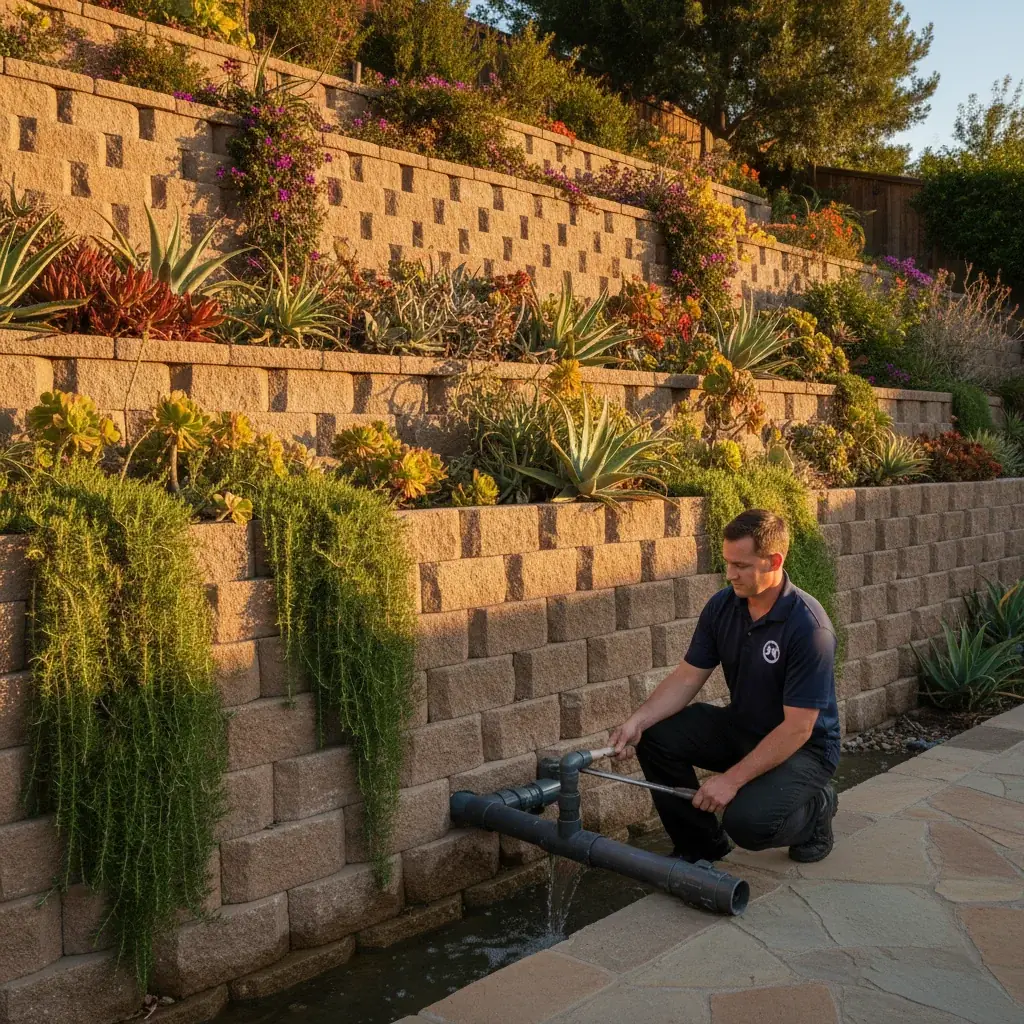
Why SD’s hillside lots drive up retaining wall cost
San Diego hillside lots add soil, access, and drainage work that a flat inland lot may not. A lot in Mission Hills, Tierrasanta, or anywhere in the east county foothills can sit on decomposed granite, expansive clay, or a mix of both, sometimes within the same cut. Soil type matters enormously. Expansive clay swells when wet and pushes against a wall with surprising force. DG is easier to cut but drains fast, which creates its own erosion pressure.
Add steep lot grades, many San Diego hillside properties have natural slopes between 2:1 and 3:1, and you quickly need more material, deeper footings, and in many cases a licensed engineer before you can pull a permit.
Labor rates reflect the region, too. San Diego’s construction labor market is tight compared with some inland California markets. Ask the contractor to show labor as its own line rather than assuming a Sacramento or Central Valley total will transfer.
Coastal proximity adds one more layer. Salt air accelerates corrosion on rebar and hardware. A contractor building a wall in Solana Beach should be using epoxy-coated rebar or stainless fasteners, and the good ones do.
Material pricing: CMU, segmental block, poured concrete, natural stone
Material choice drives the single biggest line item in any retaining wall estimate. Here’s a straightforward breakdown of what you’re looking at in San Diego right now.
Concrete masonry unit (CMU)
CMU block, standard gray cinder block, is the workhorse of commercial and residential retaining walls. It’s strong, relatively fast to lay, and takes stucco or paint well. Installed cost depends on wall height, access, drainage, and whether engineering is required. A quote should state face area, backfill, drainage, geogrid, and permit responsibility rather than a single per-face-foot headline.
Segmental retaining wall block (Allan Block, Versa-Lok, similar)
Segmental block is the most common choice for residential hillside walls in San Diego. The interlocking units are engineered for batter (backward lean) and pair with geogrid for taller applications. Installed cost depends on height, access, drainage, and geogrid. Ask for face area and those lines, not a blog per-face-foot number. The aesthetic range is wide.
Poured concrete
Poured concrete walls (cast-in-place) are structurally excellent and mandatory on some engineer-specified jobs. Forming, pouring, and a pump truck on a tight lot add cost. Service life is a specification conversation with the engineer, not a blog year count.
Natural stone
Dry-stack or mortared natural stone is usually the premium option. Cost follows stone type, transport, and fitting labor. Natural stone is rarely the cheapest structural answer, but it can be the design answer. See landscape design.
Engineering and permit thresholds (the 3-foot rule)
City of San Diego Information Bulletin 220 and unincorporated county form PDS 083 set the current permit trigger, including how height is measured and when surcharge still requires a permit on a shorter wall. Read those documents for the address. Other cities confirm their own counters. The full trigger list, surcharge examples, and what a quote should put in writing live on our retaining wall permit in San Diego page.
City fees are listed in Information Bulletin 501, not as a single published dollar number on IB 220. Other cities run their own counters. The full trigger list, surcharge examples, and what a quote should put in writing live on our retaining wall permit in San Diego page.
Before hiring anyone, verify their license through the CSLB license check. Before hiring, confirm the contractor’s CSLB classification for the wall as designed. Masonry, general building, and landscaping classifications cover different scopes. Look the license up on the CSLB site.
Drainage, geogrid, and what gets hidden in the quote
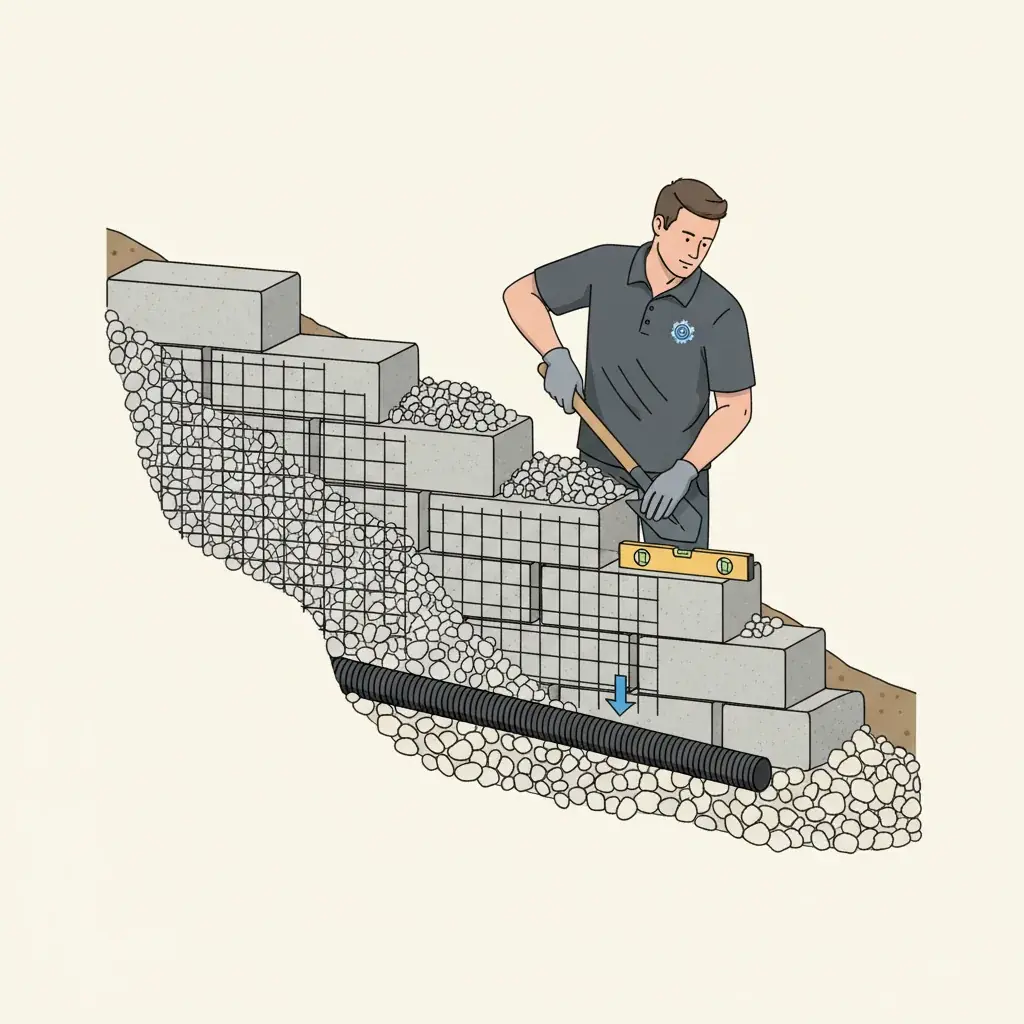
The face of the wall is what you see. The drainage system is what makes the wall last. Hydrostatic pressure, water building up in saturated soil behind a wall, is a common cause of retaining wall failure in San Diego. After a wet winter, walls fail when drainage was cut short. That is a construction-quality issue, not a brand case log.
A properly built wall behind a San Diego hillside includes:
- Perforated drain pipe at the base of the wall, sloped to daylight or a catch basin
- Class II permeable gravel backfill (or drain rock) directly behind the wall face, minimum 12 inches wide
- Filter fabric between the gravel and native soil to prevent migration
- Weep holes or gaps in the wall face as a backup pressure release
Geogrid, a woven or welded polymer grid buried in horizontal layers behind the wall, is specified on many taller segmental walls. It ties the retained soil mass into the wall system. Each layer is material and labor. The engineer or manufacturer spec, not this page, sets when it is required.
Watch out for quotes that list only “wall installation” without specifying drainage pipe size, backfill material, or geogrid layers. That’s where low-bid projects go wrong. A complete retaining wall scope should itemize every one of those components.
Tiered walls vs one tall wall: cost and code tradeoffs
A single 8-foot retaining wall sounds straightforward. In practice, it’s expensive, heavily engineered, and often unnecessary. Most residential hillside lots in San Diego are better served by two or three tiered walls of 3–4 feet each, with planting terraces between them.
Here’s why the math often works in favor of tiers:
Code: City IB 220 and County PDS 083 both trigger at 3 feet from the top of the footing, and a surcharge can trigger a permit on a shorter wall. Dropping each terrace so the measured height stays under 3 feet only helps if there is no surcharge and the local counter agrees. Confirm on the permit page, not from a 4-foot rule of thumb.
Engineering: A single tall wall often needs a structural engineer stamp. Multiple short terraces might not, if there is no surcharge and the counter agrees. Put engineering as its own line. Do not assume a fee from this page.
Material load: An 8-foot wall needs a substantially larger footing and more geogrid depth than a 4-foot wall. The material savings on three smaller walls often offset the labor of building three separate structures.
Planting opportunity: The terraces between tiered walls give you planting pockets, ideal for drought-tolerant landscaping that stabilizes the soil between walls and reduces long-term erosion pressure. That’s practical, not decorative.
The tradeoff is horizontal space. Stepping back 3–5 feet per tier eats into your usable yard. On a narrow lot, one taller engineered wall may actually be the right call.
What to compare across coastal, inland, and east county bids
A coastal wall with salt-air hardware and tight access is not the same bid as an inland clay lot or a long rural wall with a grading permit. Use the same drawing and ask each bid to show:
| Quote field | Why it changes the number |
|---|---|
| Height, length, and material | Sets face area and labor |
| Drainage, backfill, and geogrid | Often omitted from a low total |
| Engineering and permits | Confirm who owns them |
| Access and haul-off | Hillside lots add hours |
| Corrosion-resistant hardware | Coastal lots |
Get at least three itemized bids. Independent contractors set the price. Hardscaping is the service page for that match. Bloom Pro SD does not pull permits.
Frequently asked questions
How much does a retaining wall cost in San Diego?
Cost is driven by height, length, material and access. The base, the drainage rock and pipe, and any geogrid reinforcement are the parts you cannot see and cannot skip, and they are a large share of a properly built wall. A quote that is dramatically lower than the others is usually leaving out drainage or engineering.
What makes a retaining wall on a slope more expensive?
Access and engineering. Hillside lots often mean material has to be moved by hand or small equipment rather than a loader, which multiplies labor hours. Taller walls and walls carrying a surcharge from a driveway or structure above need engineered design and reinforcement, which adds both drawing cost and construction cost.
Can I save money with a wood retaining wall?
Up front, yes. Over its life, usually not. Timber walls cost less to build and have the shortest service life of the common options, so the saving is really a deferral. On a wall you expect to keep for decades, or one holding anything of consequence, the block or concrete premium is the cheaper decision.
When to call us
Retaining wall work on a hillside lot in San Diego isn’t a weekend DIY project. The permit exposure, the soil variability, and the drainage requirements all call for a contractor who knows what San Diego County inspectors are looking for. If you’ve got a slope that’s moving, a wall that’s leaning, or a new lot you’re trying to make usable, the pros we match you with can walk the site and give you a straight answer on scope and budget. Call us at (760) 400-6355 to get matched. The independent professional quotes the work.