California natives for a San Diego garden should be chosen from plants that actually grow in your ZIP code, not from a generic statewide list. Calscape is the practical starting point. UC Master Gardeners of San Diego County note that the county is among the most botanically diverse in the contiguous United States, with more than 1,550 documented native species. That richness is why a Del Mar bluff and an Alpine canyon do not share one plant schedule.
Natives are a narrower set than drought-tolerant plants for San Diego. Many Mediterranean shrubs use little water too. They did not evolve with local insects and birds. Use Calscape and a nursery tag for water, sun, and mature size. Do not copy a blog table as a watering clock.
Why natives belong in a San Diego garden
UC Master Gardeners of San Diego County say native plants are less work and use less water, and that they help increase garden biodiversity. They write that native plants and animals evolved together, and that insects may not recognize a non-native plant as food.
UC Master Gardeners place the local rainy season at about October through April. Once plants are established, summer water may not be needed. They tell you to learn each plant’s summer needs (Calscape is named as a conditions tool) and to learn the native habitat: stream-associated natives need more water than coastal sage scrub plants.
This page does not publish household water-bill percentages or wildlife headcounts. Those numbers are not in our retained sources.
How to pick natives for one San Diego lot
There is no county-wide plant table on this page. Enter your ZIP on Calscape and compare sun, water, and mature size to the actual yard. Confirm the nursery tag before you buy. For trees more broadly, see drought-tolerant trees for San Diego. For screening, see drought-tolerant shrubs. Confirm any fire-authority vegetation rules for the parcel separately.
How to plant natives in San Diego
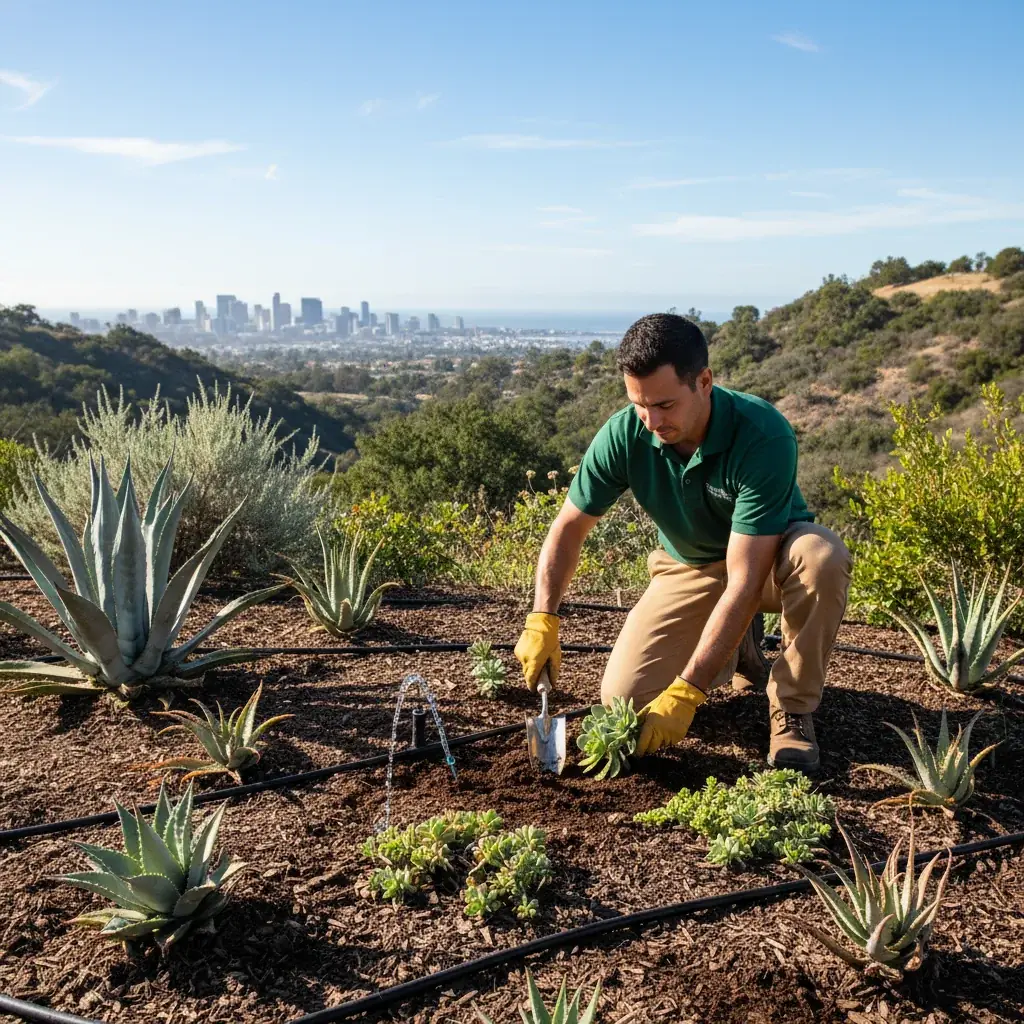
UC Master Gardeners: plant in the rainy season so natural rainfall helps roots establish. Water as needed during the first several months so roots stay moist. The later you plant into the dry season, the more supplemental water the plant needs. Set the plant slightly higher than surrounding grade (about 1 inch), backfill with native soil, and do not add fertilizer. Keep mulch off the stem.
Once plants are established, summer water may not be needed. Learn each plant’s dry-season needs on Calscape.
SoCal Water$mart turf-replacement projects require a three-inch-deep ring of mulch around plants. Projects in a CalFire designated Very High Fire Severity Zone may use inorganic mulch such as rock or decomposed granite in place of organic mulch. That program rule is not a substitute for the UC stem-clearance advice. Keep mulch off the crown.
For slopes, get a site-specific erosion and drainage assessment. See groundcovers for San Diego slopes.
Rebates: current SoCal Water$mart rules, not a local dollar guess
Natives can be part of a turf-replacement design. They do not automatically qualify. SoCal Water$mart eligibility requires existing live turf, approval to proceed before any turf is removed, and a completed project that meets plant, stormwater, permeability, mulch, and irrigation rules. Dead or dying turf and bare dirt do not qualify. Synthetic turf is not allowed. Turf-looking grasses and invasive plants do not qualify even if they are drought-tolerant or California natives.
SoCal Water$mart turf replacement requires approval before removal. Live turf must exist. Dead turf and synthetic turf do not qualify. Minimum area is 250 square feet, or all turf if the site has less. At least three plants per 100 square feet. Amounts, caps, and funding change. Use the program estimator and your water bill agency before you budget a dollar figure.
Plant density on a qualifying conversion is at least three plants per 100 square feet of project area. Existing trees that remain count. The eligibility page tells applicants to visit Calscape for native plant lists specific to the area.
Ask the independent contractor, in writing, who files the application. Bloom Pro SD does not file rebate paperwork and does not promise approval.
Where to buy
Calscape lists plants by condition for your ZIP. Confirm nursery stock and seed source locally. Local-genotype stock is a nursery conversation, not a guarantee on this page.
Frequently asked questions
What California native plants grow well in San Diego?
There is no single county list. Enter your ZIP on Calscape and compare sun, water, and size to the actual yard.
Do California native plants really need no summer water?
Not as a blanket rule. UC Master Gardeners say that once plants are established, summer water may not be needed, and that you should learn each plant’s summer needs on Calscape. Stream-associated natives need more water than coastal sage scrub plants.
What are the best native trees for San Diego?
The tree has to fit canopy, roots, soil, and fire rules for the parcel. Mature size and summer water come from the tag and Calscape, not from a county list on this page.
Do California native plants qualify for San Diego water rebates?
They may, when they are part of an approved turf-replacement project that meets current SoCal Water$mart rules. Approval comes before removal. Check the estimator for your address. There is no separate “native-only” dollar amount on this page.
How is a California native plant different from a drought-tolerant plant?
A native is indigenous to the place you are planting. A drought-tolerant plant can come from another dry climate. Rebate projects with invasive plants or impermeable surfaces replacing the turf area are ineligible. Ecological value is a reason to prefer natives. It is not a substitute for eligibility rules.
Where can I find California native plants for sale in San Diego?
Start with Calscape for plants that match your ZIP and conditions. Confirm nursery stock and seed source locally. Local-genotype stock is a nursery conversation, not a guarantee on this page.
When to call us
Matching natives to sun, soil, drainage, and irrigation zones is a site walk. Bloom Pro SD is a referral service. We match you with licensed independent landscapers who design and install. You contract and pay them directly. They set the written quote.
Call (760) 400-6355 for a contractor match. For a full redesign, see landscape design and drought-tolerant landscaping.