Start by comparing the named cultivars and your site rather than choosing from the grass names alone. Bermuda is commonly considered for sunny, active areas, while St. Augustine is commonly considered where partial shade is a constraint. The product supplier or a qualified local professional should confirm light, irrigation, mowing, dormancy, and installation requirements for the cultivar you can actually buy.
St. Augustine grass in San Diego
St. Augustine is the shade answer, not the default inland lawn. It is a coarse, blue-green, stolon-spreading turf that holds under marine layer and tree canopy better than bermuda. It is usually installed as sod or plugs, not seed. If your search was “St. Augustine grass San Diego,” this comparison is the decision: plant it for shade and coastal lots, skip it for full-sun East County heat.
This page compares bermuda against St. Augustine only. For bermuda measured against fescue, kikuyu and zoysia, see our guide to best grass types for San Diego lawns.
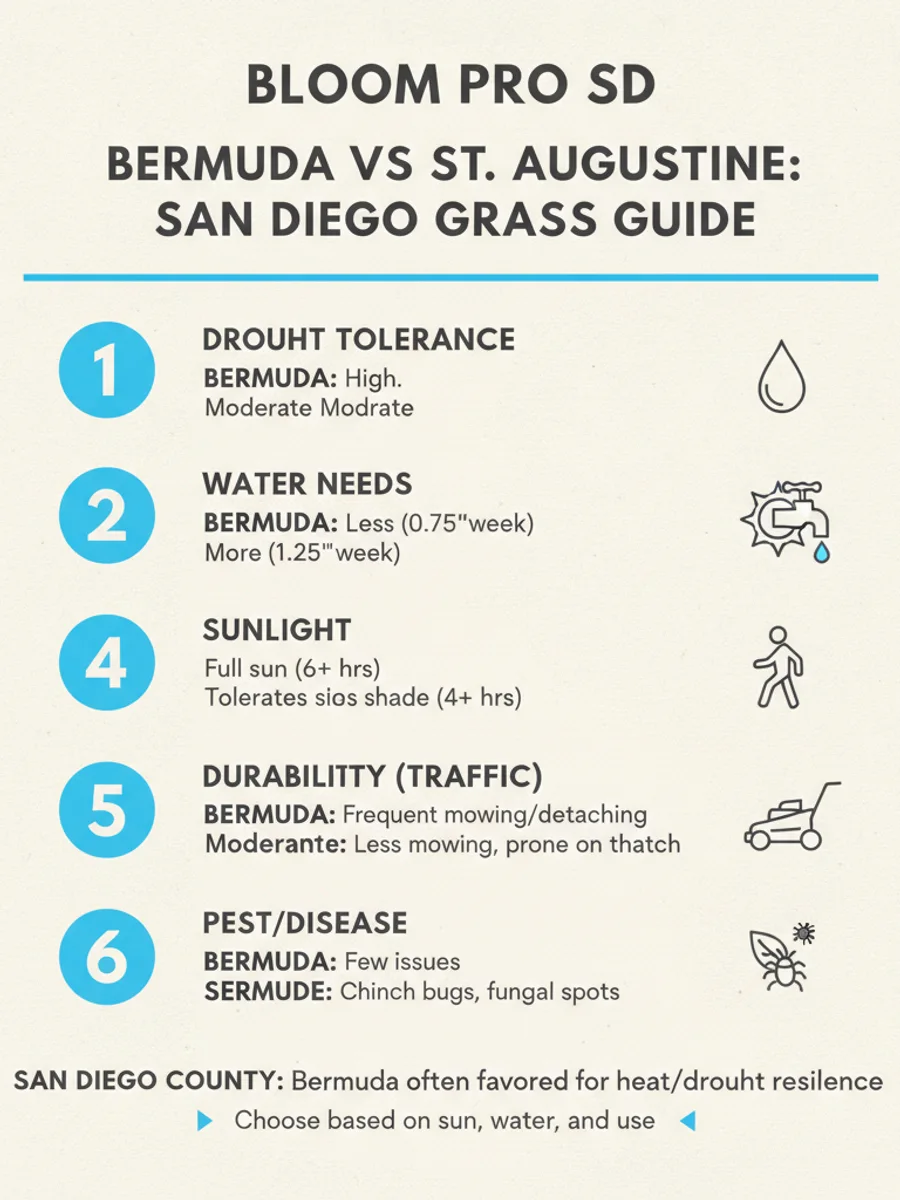
Bermuda vs St. Augustine at a glance
| Feature | Bermuda grass | St. Augustine grass |
|---|---|---|
| Blade texture | Fine, narrow | Coarse, broad |
| Water use | Confirm for the cultivar and site | Confirm for the cultivar and site |
| Shade tolerance | Generally prefers strong sun; verify product guidance | Often considered for partial shade; verify product guidance |
| Foot traffic | Very high | Good; self-repairs via stolons |
| Drought tolerance | Excellent | Moderate |
| Mowing height | Use cultivar guidance | Use cultivar guidance |
| Mowing frequency | Adjust to growth and the one-third rule | Adjust to growth and the one-third rule |
| Installed cost | Compare itemized local quotes | Compare itemized local quotes |
| Winter color | Goes dormant, turns brown | Semi-dormant; tan in cold snaps |
| Best SD zones | Inland valleys, sports yards, full-sun | Coastal, canyon-shaded, North County coast |
| SDCWA rebate eligible? | No | No |
Availability and requirements vary by cultivar, supplier, property, and installation scope.
Sun exposure: the single biggest factor in San Diego
In San Diego, where a yard can shift from coastal fog to scorching inland heat depending on your zip code, sun exposure is what decides this comparison.
Bermuda generally performs best with strong sun and can thin in shade, but one universal hour threshold is not supported for every cultivar and site. Record the direct light across the proposed lawn and compare it with the supplier’s technical guidance.
St. Augustine is often evaluated for partial-shade areas where Bermuda struggles. It still needs adequate light, irrigation, and site conditions. Ask the supplier to document the selected cultivar’s minimum light requirement rather than treating a neighborhood or grass name as proof of fit.
Water use and drought tolerance
Bermuda is a warm-season turf. UC guidance in the retained source set says warm-season grasses generally require less water than cool-season grasses, but it does not establish one Bermuda-versus-St. Augustine percentage or weekly amount for every San Diego yard. Irrigate from observed plant and soil needs while following current provider rules.
Do not assign St. Augustine a fixed weekly amount without the cultivar, soil, exposure, irrigation efficiency, weather, and local restrictions. Ask how the recommendation will change between establishment and an established lawn.
Neither grass qualifies for San Diego County Water Authority turf-replacement rebates. If water savings is your highest priority, the drought-tolerant landscaping route or a turf-alternative groundcover deserves a look before you commit to either variety. See our drought-tolerant landscaping service for what that path looks like.
Mowing, maintenance, and the time cost
This is where the two grasses feel most different week to week.
Bermuda can grow quickly in active growth. Set mowing height from the cultivar guidance and avoid removing more than one-third of the blade in one mowing, following UC IPM guidance. Inspect for thatch before scheduling a separate treatment rather than assuming an annual task.
St. Augustine commonly uses a different mowing height from Bermuda, but the selected cultivar and current growth should determine the setting and visit interval. Apply the same one-third rule.
Do not fertilize either lawn from a generic calendar. Identify the grass, inspect the lawn, and use current product directions and a property-specific recommendation. Lawn fertilization service can help assess that scope.
Foot traffic, dogs, and active yards
Bermuda is commonly selected for active, sunny turf because it spreads laterally, but concentrated traffic can wear any lawn. Compare the cultivar’s stated traffic tolerance and the site’s recovery conditions.
St. Augustine handles moderate traffic well. Its stolon-based spreading fills in worn spots over time, but it takes longer to recover than Bermuda under concentrated impact. It’s a solid lawn for a family yard, just not the right choice if you need athletic-field-level resilience.
Pet use adds wear and lawn-health variables that this source set does not resolve by grass type. Avoid automatically deep-watering after every use; show recurring damage to a qualified lawn professional and account for drainage, irrigation rules, and the pet’s routine.
Install cost and which goes in first
Compare current itemized quotes for the cultivars available to your address. Include removal, soil preparation, grading, irrigation correction, sod or other planting material, delivery, labor, disposal, and establishment instructions.
Installation and establishment directions can differ by product and site. Require the installer to state preparation, fertilizer if justified, placement, first watering, access restrictions, and the handoff schedule in writing. Our sod installation cost guide for San Diego covers quote-scope questions.
The San Diego verdict
Pick Bermuda when:
- The named cultivar’s light requirement matches the measured site
- You’re in an inland valley, Escondido, El Cajon, Santee, Poway, Ramona
- High foot traffic, dogs, or active kids are part of the picture
- Water efficiency is a priority
- You want the finest texture and the tightest, most manicured look
Pick St. Augustine when:
- Partial shade is the main constraint and the named cultivar’s guidance matches the site
- You’re in a coastal or semi-coastal zone, Encinitas, Pacific Beach, Carlsbad, Oceanside, La Jolla
- You want a wider blade, a softer look, and a slower mowing pace
- Foot traffic is moderate, not heavy
If you’re still sorting out which warm-season grass fits your specific situation, our guide to kikuyu vs. Bermuda grass in San Diego adds another common alternative to the comparison. The full breakdown across all major SD grass types lives at best grass types for San Diego lawns. And if shade is your real issue, the St. Augustine vs. fescue comparison covers how St. Augustine stacks up against a cool-season option.
Frequently asked questions
Is Bermuda or St. Augustine better for San Diego?
It depends on the named cultivars, measured light, traffic, irrigation, maintenance, dormancy preference, and product availability. Bermuda is commonly evaluated for sunny active areas; St. Augustine is commonly evaluated where partial shade is the main constraint.
Which grass handles shade better, Bermuda or St. Augustine?
St. Augustine is generally more shade tolerant than Bermuda, but a grass name does not establish an exact light threshold. Compare the available cultivars’ technical guidance with light measured in the proposed lawn area.
Which uses less water in San Diego, Bermuda or St. Augustine?
The retained source set does not support one Bermuda-versus-St. Augustine percentage for every yard. Water need varies with cultivar, soil, exposure, weather, irrigation efficiency, and desired appearance. Request a site-specific plan that follows current provider rules.
Which needs less mowing, Bermuda or St. Augustine?
Frequency depends on growth and the correct height for the cultivar. Ask the supplier for the height range, then mow often enough to avoid removing more than one-third of the blade in one cut.
Is Bermuda or St. Augustine better for dogs and high-traffic yards?
Bermuda handles high traffic and dog use better. Its aggressive stolon and rhizome growth recovers quickly from worn paths, divots, and concentrated foot traffic. St. Augustine self-repairs via stolons too, but at a slower rate under heavy impact. For a large yard with active dogs or regular outdoor gatherings, Bermuda bounces back faster.
Which costs more to install, Bermuda or St. Augustine?
Current product availability and the full installation scope determine the difference. Compare itemized quotes for removal, preparation, irrigation work, material, delivery, installation, disposal, and establishment care.
Is St. Augustine grass a good choice in San Diego?
It fits specific yards rather than most yards. Its strength is shade tolerance, which is where bermuda thins out, so it earns its place under trees and along shaded side yards. The trade-offs are higher water use than bermuda and a coarser blade. It is also not practical from seed, so a St. Augustine lawn means sod, stolons or plugs.
When to call us
If you’re ready to install sod or still deciding which grass fits your yard, we cover all of San Diego County. The crews we match you with handle site prep, grading, sod selection, and installation so your new lawn establishes clean from the first watering. Call us at (760) 400-6355 to get matched. The independent professional quotes the work.