A drought-tolerant front yard is a common San Diego direction, not a universal best. A focal plant or boulder plus drip and a permeable surface can work when the plants match the site. Confirm rebate rules in the estimator if you are replacing living lawn.
San Diego landscaping ideas that actually fit this climate
Yardzen-style idea boards lean tropical banana rows and lilac-vine hammocks. Those can work in a frost-free pocket. Most county lots need one of these instead:
- Privacy screen plus low-water interior. Fast hedge (Podocarpus, not Ficus next to the house) with sage and grasses inside.
- Desert front yard. Palo Verde, gravel, boulders, agave. Lowest water, check HOA.
- Spanish or Craftsman Mediterranean. Lantana, rosemary, olive, decomposed granite paths.
- Small lot. One tree, oversized pavers, clumping grasses. Skip a lawn.
- Kids and dogs. A small hybrid-bermuda or Kurapia patch, not a full fescue yard, plus a durable path.
- View lot. Keep plants low so the canyon or ocean stays the feature.
Which style fits your San Diego home? A decision framework
Before picking plants, match the style to your house, your HOA rules, and how much sun your front faces. The table below covers the four styles that work best in San Diego County.
| Style | Best for | Water use | Relative cost | HOA-friendly? |
|---|---|---|---|---|
| Modern desert (agave + DG) | Contemporary, stucco, flat lots | Very low | Lower | Confirm packet |
| Coastal/Mediterranean | Spanish, Craftsman, beach cities | Low | Mid | Confirm packet |
| Cottage (low-water perennials) | Traditional, bungalows | Low–moderate | Mid | Confirm packet |
| Rock xeriscape | Any / minimal HOA | Lowest | Lower | Confirm packet |
Installed dollar ranges live on drought-tolerant landscaping costs in San Diego.
West-facing yards in coastal cities (Encinitas, La Jolla, Carlsbad) stay milder; agaves and Mediterranean shrubs both do well. South-facing yards in inland areas (El Cajon, Santee, Escondido) face hotter, drier conditions, lean toward succulents, native shrubs, and decomposed granite with a deep drip system. Shaded north-facing yards can handle low-water ferns, Australian flax, and groundcovers that struggle in full sun.
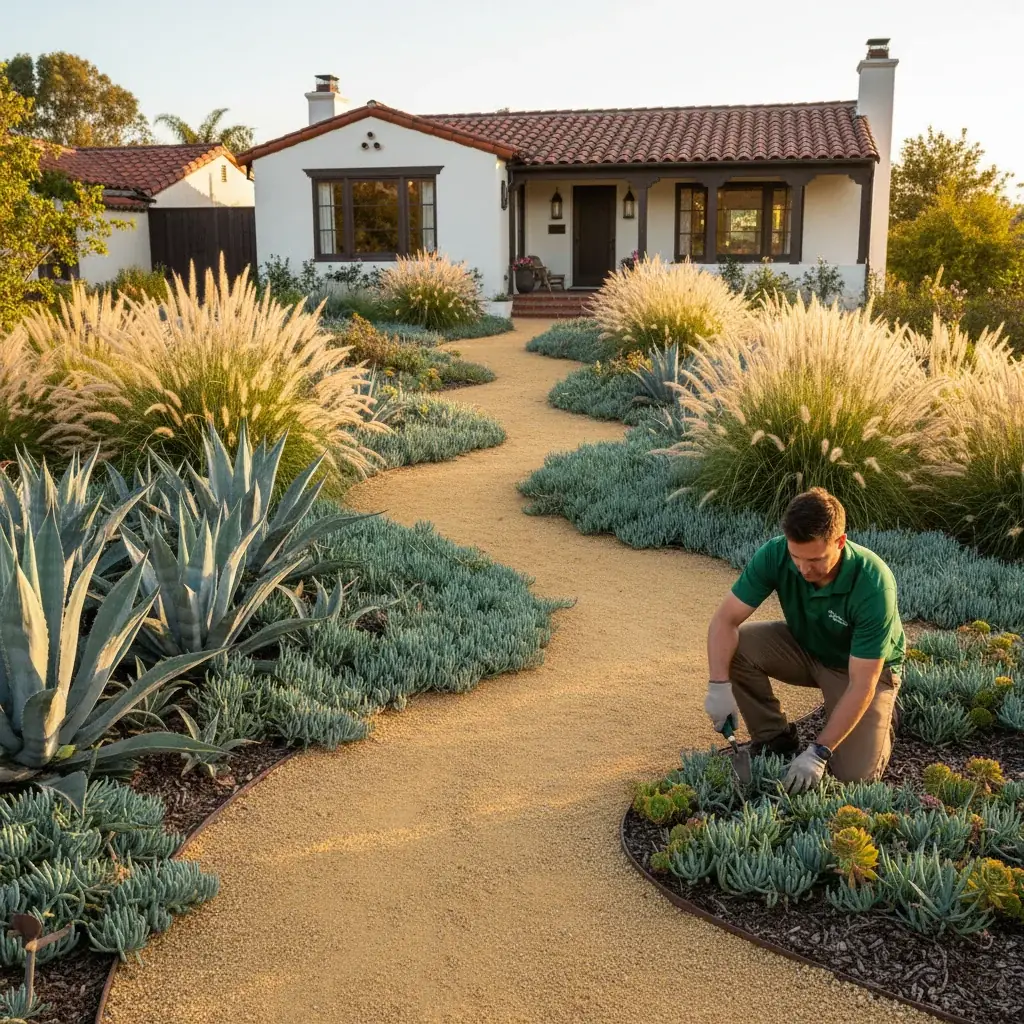
The drought-tolerant classic: agave, grasses, decomposed granite
This is the quintessential Southern California look, and for good reason. It’s sculptural, low-maintenance, and perfectly suited to our environment. This style isn’t about looking barren; it’s about creating texture, form, and year-round interest with plants that have evolved to handle dry conditions.
The key elements are:
- Structural succulents: Agaves, aloes, and yuccas provide bold, architectural focal points. A single, dramatic Agave americana or a cluster of smaller, more refined Agave ‘Blue Glow’ can anchor an entire garden bed.
- Softening grasses: Ornamental grasses like deer grass (Muhlenbergia rigens) or blue fescue (Festuca glauca) add movement and a softer texture that contrasts beautifully with the sharp lines of succulents.
- Permeable surfaces: Decomposed granite (DG) allows water to percolate back into the ground instead of running off. It’s affordable, comes in various colors, and provides a clean, neutral backdrop for plants.
A starter plant list that performs across most of San Diego County: Agave ‘Blue Glow’ and Agave attenuata for structure, red yucca (Hesperaloe) for summer-long bloom, kangaroo paw (Anigozanthos) for color, deergrass and blue fescue for softness, and an underplanting of dymondia or trailing rosemary to cover the soil.
This layout is a cornerstone of drought-tolerant landscaping, and it’s highly adaptable. You can create a dense, layered look or a more sparse, desert-inspired feel depending on plant spacing and the use of accent boulders.
The Mediterranean revival: lavender, olive, gravel paths
Given our climate is officially classified as Mediterranean, it makes sense to draw inspiration from the hills of Italy, Spain, and Greece. This style is romantic, fragrant, and feels effortlessly timeless in a San Diego setting. It’s less about sharp, modern lines and more about relaxed, sun-baked elegance.
Here’s how to get the look:
- The plant palette: Non-fruiting olive trees provide a wispy, elegant canopy. Hedges of rosemary and fields of lavender offer incredible fragrance and color. Bougainvillea on a wall or trellis brings vibrant color that handles our dry summers without complaint.
- Warm hardscaping: Use gravel or flagstone for meandering paths. Low, rustic stone walls define garden beds. Stucco walls in warm whites, ochres, or tans provide the perfect backdrop.
- Casual layout: Paths curve gently, plants spill over edges, and seating areas tuck into shaded corners.
A quick SD-specific plant list for this style: non-fruiting ‘Swan Hill’ or ‘Wilsonii’ olive, ‘Provence’ or Spanish lavender, prostrate and upright rosemary, Westringia (coast rosemary), germander, santolina, and a climbing bougainvillea on a south wall. All of it sips water once it’s settled in.
This style works exceptionally well for homes with Spanish or Mission-style architecture and pairs naturally with an HOA-review package, the formal structure reads as intentional.
The modern minimalist: clean hardscape with structural plants
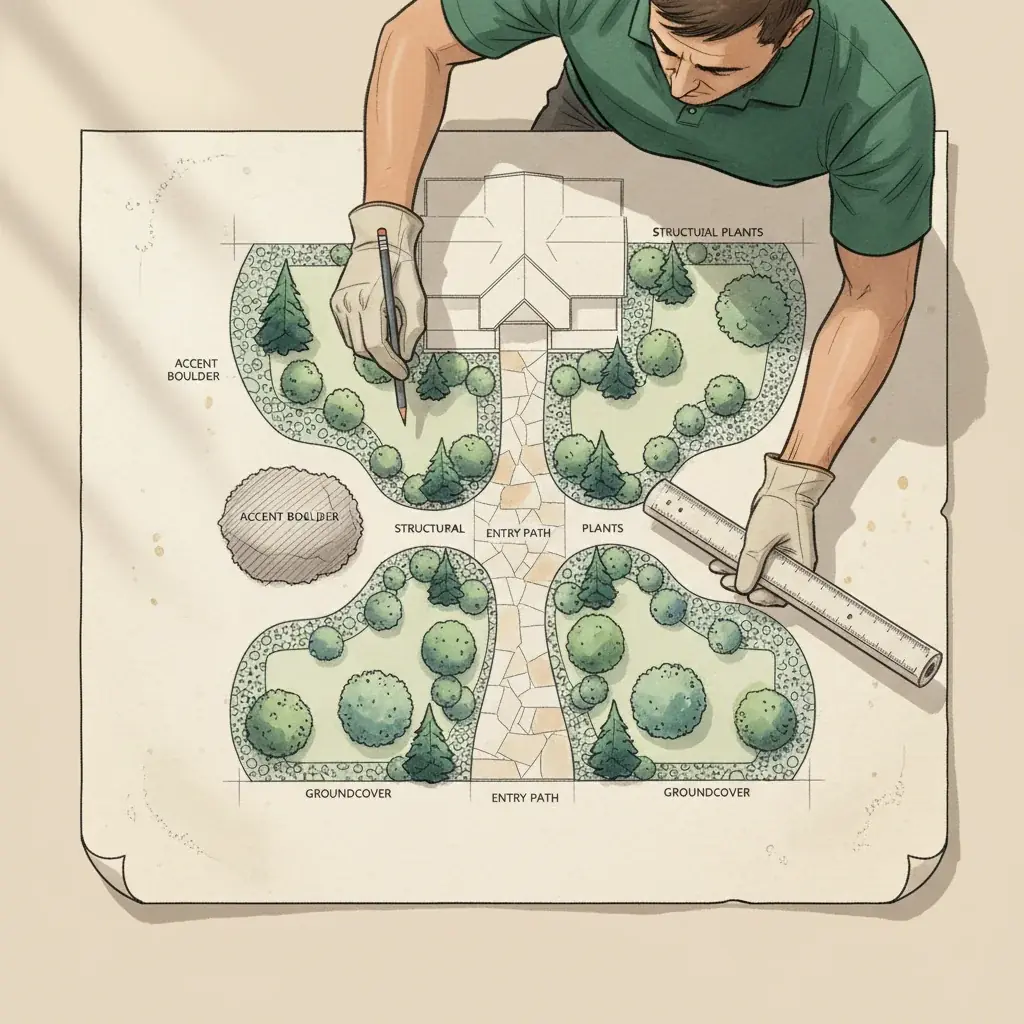
If your taste leans contemporary, a modern minimalist front yard can make a powerful statement. The approach uses restraint, clean lines, geometric forms, and a highly curated selection of plants and materials.
The core principles include:
- Strong geometry: Large-format concrete pavers set in straight lines, raised planter beds made of board-formed concrete or steel, and linear water features define the layout.
- Limited plant palette: Instead of a dozen different plants, a minimalist design might use only three or four species, repeated in organized groups, snake plant, a single palo verde tree, or horsetail reed (Equisetum hyemale) in a long trough.
- Monochromatic colors: Greys, whites, and blacks dominate the hardscaping, with green from the plants providing the primary color.
This style requires precise installation and a clear vision from the start. A thoughtful landscape design plan up front is the cheapest insurance against an expensive layout mistake.
The cottage adapted: low-water perennials with color rhythm
You can achieve the charming, flower-filled aesthetic of a cottage garden in San Diego by making smart plant substitutions, trading thirsty traditional perennials for beautiful, water-wise alternatives.
- Choose the right flowers: Swap water-guzzling favorites for tough bloomers. Instead of delphiniums, try salvias like ‘May Night’ or ‘Mystic Spires’. Instead of hydrangeas, use masses of flowering lantana or lion’s tail (Leonotis leonurus). Yarrow (Achillea), penstemon, and gaura (‘Whirling Butterflies’) provide long-lasting blooms without demanding constant water. Our guide to drought-tolerant plants in San Diego has dozens more ideas.
- Layer and repeat: Place taller plants in the back, medium-sized ones in the middle, and low-growing groundcovers at the front. Repeat colors throughout for rhythm and cohesion.
- Incorporate texture: Mix in fine-textured plants like Mexican feather grass (Nassella tenuissima) to soften the edges and add movement between bolder, flowering perennials.
The California native: chaparral plants that belong here
If you want a front yard that supports local wildlife and asks almost nothing of you once established, go native. These plants grew in San Diego County before anyone planted a lawn. They are adapted to our dry summers, soils, and pollinators. The turf rebate is still the current estimator amount of removed live turf. There is no extra native-plant dollar on top of that in the current SoCal Water$mart rules.
A reliable SD native palette:
- Anchor shrubs: Cleveland sage (Salvia clevelandii ‘Winnifred Gilman’), white sage (Salvia apiana), lemonade berry, and toyon for taller screening.
- Color and structure: Manzanita (‘Howard McMinn’ takes garden conditions well), California lilac (Ceanothus ‘Concha’ or ‘Ray Hartman’), and monkeyflower (Diplacus) for spring bloom.
- Groundcover and accents: California poppy reseeds itself, while deergrass and ‘Canyon Prince’ wild rye give movement.
Plant in fall, water to establish through the first year, then back off hard. Overwatering kills more native gardens in San Diego than drought ever does.
The rock and gravel xeriscape: lowest water, lowest upkeep
A xeriscape uses rock, gravel, boulders, and a sparse, deliberate scatter of drought-tolerant plants to deliver year-round structure with almost no watering or trimming.
How to keep it from looking like a parking lot:
- Vary the rock. Mix 3/8-inch crushed gravel as the main field with river-cobble drifts and two or three large feature boulders.
- Plant in clusters, not dots. Group three or five plants of the same kind so they look planned.
- Add one or two strong forms. A multi-trunk palo verde, a barrel cactus, or a tall agave gives the eye a place to land.
- Use commercial-grade weed fabric under the rock, with gaps cut only at planting holes.
One important note: most San Diego turf rebates require living plants, not bare rock or synthetic turf. A pure gravel yard usually won’t qualify, and a yard that’s all artificial grass definitely won’t. Keep enough living, low-water plants in the mix and you stay eligible.
The turf-alternative lawn: a soft, walkable surface without the water bill
Some households still want a patch of green to walk on or let the kids play on. Several living ground covers give you a lawn-like surface at a fraction of the irrigation:
- Kurapia spreads fast, handles moderate foot traffic, and uses far less water than fescue or Bermuda.
- UC Verde buffalograss is a warm-season native turf that goes light-gold in winter and green in summer, mowed only a few times a year.
- Dymondia margaretae stays low, silvery, and tidy between pavers or as a small play-free lawn.
- Carex pansa (California meadow sedge) gives a soft, meadow look you can leave unmowed or trim once or twice a year.
Those living substitutes can qualify for SoCal Water$mart if the conversion meets the program’s plant, stormwater, and irrigation rules. Synthetic turf does not.
What a San Diego front yard actually costs
Every yard is different. Get a written bid for your lot. Dollar ranges by scope live on drought-tolerant landscaping costs in San Diego.
A formal landscape design plan up front is the cheapest insurance against a costly layout mistake.
The turf rebate: get paid to remove your front lawn
This is the part most homeowners miss. If you’re tearing out a living grass lawn, San Diego water agencies will pay you to do it.
Here’s how the math works in 2026:
- Base rebate: The regional SoCal Water$mart turf replacement program pays the current estimator amount per square foot of living grass removed, up to 5,000 square feet per year.
- Local top-ups: Your own water agency may add an incentive on top of the regional rate. Those amounts vary by district and some are funded in limited rounds, so check what the agency named on your water bill offers rather than assuming a countywide number.
- Nothing is fixed until approval: Rebate amounts are subject to change and depend on funding available when your application is approved, which happens after review and a property inspection.
So an 800 square foot front lawn returns whatever the approved estimator and reservation show, plus whatever your agency adds. Two rules that trip people up: the program requires living, drought-tolerant plants in place of the lawn, and you almost always have to apply and get approved before you remove anything. Our breakdown of the San Diego drought-tolerant rebates for 2026 walks through the steps and current numbers. You can also confirm water-wise guidelines through the San Diego County Water Authority.
HOA rules
If you’re in an HOA, do not assume a drought-tolerant front yard is banned, and do not treat a blog as legal advice. Submit a clean plan with defined bed edges and a tidy planting layout. Confirm the current rule in your HOA packet.
Slope and corner-lot layouts that solve common SD problems
Many San Diego properties aren’t flat, easy rectangles. We have canyons, hillsides, and corner lots that present unique landscaping challenges. A smart design can turn these “problems” into features.
Sloped yards: The biggest issues on a slope are erosion and water runoff. A terraced design with retaining walls creates level planting areas and allows water to soak in where it’s needed. Use deep-rooted, low-water plants, prostrate rosemary or myoporum, to stabilize the soil. Drip irrigation is essential on slopes to deliver water directly to the roots without waste.
Corner lots: Anchor the corner with a significant feature, a mature multi-trunk tree (crape myrtle or desert museum palo verde), a large statement boulder, or a substantial bed of architectural plants. Layer plants to soften the corner and create depth. Ensure a clear, welcoming path from the public sidewalk to your front door.
Curb appeal and resale value
A mature, low-maintenance, drought-tolerant front yard often reads as a feature to buyers here, not a compromise, because there is no weekly mow. A thoughtful design installed well looks finished. A half-finished gravel patch with struggling plants does not.
Frequently asked questions
What’s the best front yard landscaping for San Diego?
A drought-tolerant design with one strong focal element, an agave, a multi-trunk palo verde, or a large boulder, works best for most San Diego homes. Pair it with ornamental grasses, low-water shrubs, and decomposed granite on drip irrigation. It handles our dry summers and can qualify for the SoCal Water$mart turf rebate if you are replacing a living lawn.
How much does front yard landscaping cost in San Diego?
Get a written bid for your lot. An approved reservation pays only what the program and your agency award for the measured qualifying area.
What are the cheapest front yard landscaping ideas for San Diego?
Rock and gravel xeriscape is usually the lowest upfront cost for a typical front yard. A drought-tolerant classic with smaller 1- and 5-gallon plants and decomposed granite is close behind. Both styles have almost no ongoing water or maintenance cost, which makes them the lowest total-cost option over five years. Confirm numbers on drought-tolerant landscaping costs in San Diego.
What are the best low-water front yard plants for San Diego?
Top performers include Agave attenuata (soft, no spines, safe near walkways), Cleveland sage, California lilac (Ceanothus), deergrass, kangaroo paw, red yucca (Hesperaloe), and trailing rosemary. For a lawn alternative, Kurapia and UC Verde buffalograss give a walkable surface at a fraction of the water use. See our full list of drought-tolerant plants for San Diego.
Do I need a permit to landscape my front yard in San Diego?
Plant and irrigation work generally doesn’t require a permit. Retaining walls over a certain height, significant grading, or anything in the public right-of-way often does. Confirm with your city before building structural elements, rules vary between the City of San Diego, Chula Vista, Escondido, and unincorporated county areas.
How do I boost curb appeal in San Diego on a tight budget?
Start with fresh mulch or decomposed granite over existing beds, which costs a few hundred dollars and immediately makes everything look intentional. Add one statement plant, a large agave or a multi-trunk palo verde, as a focal point. Then apply for the turf rebate before you remove anything, so the rebate money helps fund the rest of the install. Small improvements in sequence add up faster than one big overhaul.
What are the best landscaping ideas for a San Diego front yard?
Front yards carry more weight than back yards in San Diego, both for kerb appeal and for the turf rebate, which applies to removing irrigated lawn and the front lawn is usually the largest piece of it. The ideas that hold up here are the ones that work with the climate rather than against it: low-water planting with real structure, permeable ground surface instead of thirsty turf, and a clear path and entry that reads as intentional from the street.
When to call us
Thinking through ideas is the fun part. When it comes to grading, irrigation, hardscaping, and selecting the right plants for your specific soil and sun exposure, a professional plan makes all the difference. The contractors we match you with also handle the rebate paperwork so you don’t leave money on the table.
For a deeper look at what’s involved before you spend anything, see drought-tolerant landscaping and landscape design.
Call us at (760) 400-6355 to get matched. The independent professional quotes the work.