Pre-emergent herbicide is one of the most effective tools in weed control, and one of the most wasted. Apply it two weeks too late and you’ve spent money on fertilizer for weeds. Apply it too early and it breaks down before seeds even germinate.
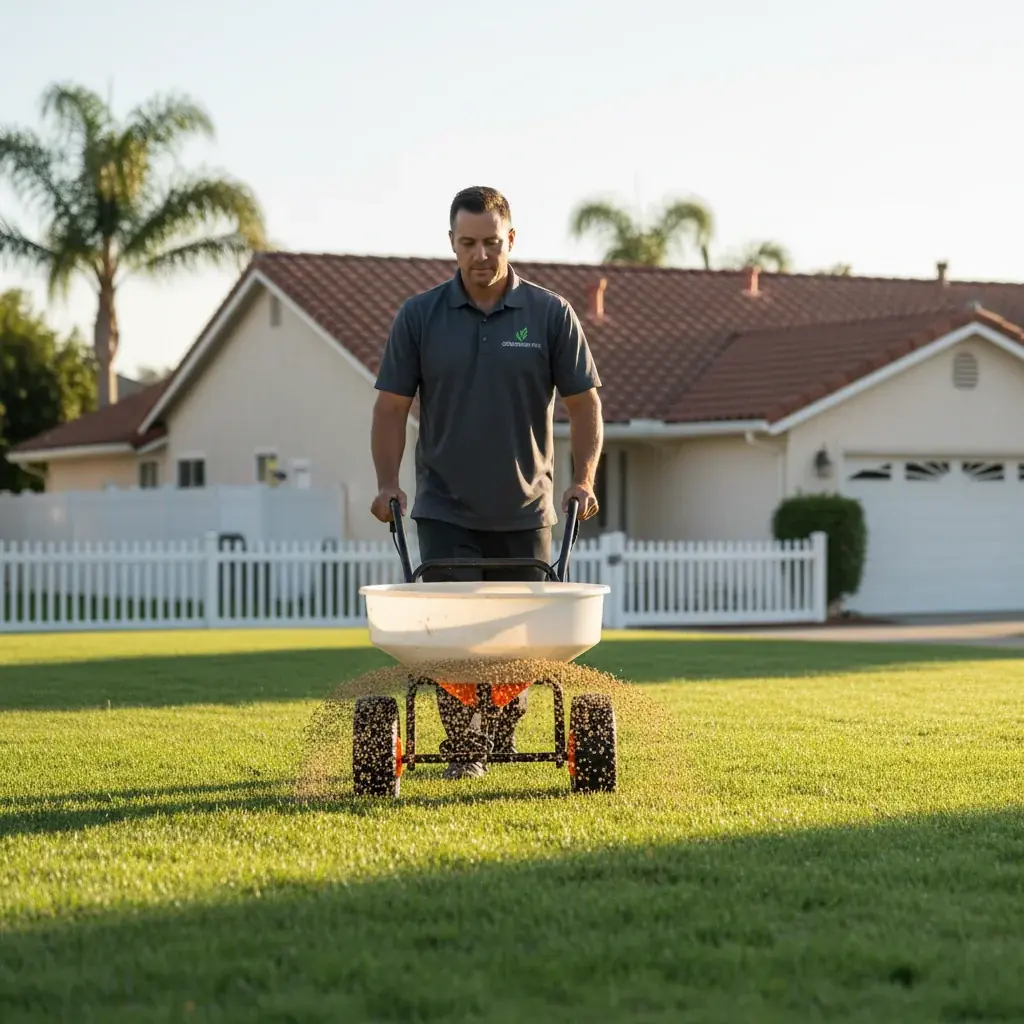
Why generic timing charts fail in San Diego’s climate
Most pre-emergent guides are written for the Midwest or the Southeast. They say things like “apply in early spring when forsythia blooms.” That’s useless here.
San Diego doesn’t have forsythia. More importantly, San Diego doesn’t have a real winter. Coastal lots stay milder than inland lots. El Cajon, Santee, and the hills east of Escondido swing harder. Measure soil temperature at the depth the label names rather than copying a remembered January or February reading.
Pre-emergent herbicides work by creating a chemical barrier in the top inch of soil. That barrier stops germinating seeds from establishing roots. But the timing of germination is driven by soil temperature, not by the month on your calendar.
Weed germination follows soil temperature and moisture, not a Midwest calendar. Confirm the species and the product label. A soil thermometer at the depth the label names is more useful than a date. Year-round irrigation can keep soil moist and shift windows. Do not treat 3 to 6 weeks as a measured San Diego offset.
The fix is a soil thermometer and the product label, not a remembered hardware-store price. Push it to the depth the label names, in the morning, for several days. Those readings plus the identified weed drive timing, not a date on a national chart.
Soil temperature triggers for crabgrass, oxalis, and spurge
These three weeds dominate San Diego lawns, and each has a distinct germination threshold.
Crabgrass
Measure soil temperature at your lawn. Coastal lots often stay cooler than inland lots. Neighborhood dates are guesses. The identified weed and the label drive the application.
Your pre-emergent needs to be down and watered in before the species germinates. Use the soil-temperature trigger on the product label, not a remembered °F number.
Oxalis (sourgrass)
Oxalis is a cool-season germinator, meaning it sprouts when soil cools in fall, not when it warms in spring. Oxalis shows up when soil cools in fall. Confirm the species on your lawn. It is a common complaint on fescue in North County and Mission Valley.
A fall pre-emergent application targets oxalis. Don’t wait for a spring application to handle it, by then it’s already established and you’re into post-emergent territory.
Spurge
Spurge, the flat, mat-forming weed that takes over warm turf, germinates when soil is warm enough and can keep coming through summer. Inland lots often see it earlier than coastal lots. Follow the label and a soil thermometer, not a March appointment. A second labeled application can extend coverage if the first residual has run out.
Products containing pendimethalin or dithiopyr are commonly used for all three. Dithiopyr has the added benefit of some post-emergent activity on young crabgrass seedlings, which gives you a small margin of error if your timing slips slightly.
Fall pre-emergent window for cool-season weeds
The fall pass targets oxalis, annual bluegrass (Poa annua), and common chickweed. Those are cool-season germinators. The month is not a county rule. Use soil temperature at the depth the label names.
Watch soil temperatures at the depth the label names. When they are cooling through the range the product names for cool-season weeds, it is time to apply. Coastal lots often cool sooner than inland lots. Measure it.
Irrigation timing matters here too. After spreading granular pre-emergent, you need about a half-inch of water to activate it. A standard lawn maintenance schedule can handle this, but you’ll want to confirm the watering-in step happens within 24–48 hours of application.
One common mistake: skipping the fall application because the lawn looks clean. Cool-season weed seeds are already in the soil waiting for germination conditions. A clean-looking lawn in August doesn’t mean you’re weed-free in November.
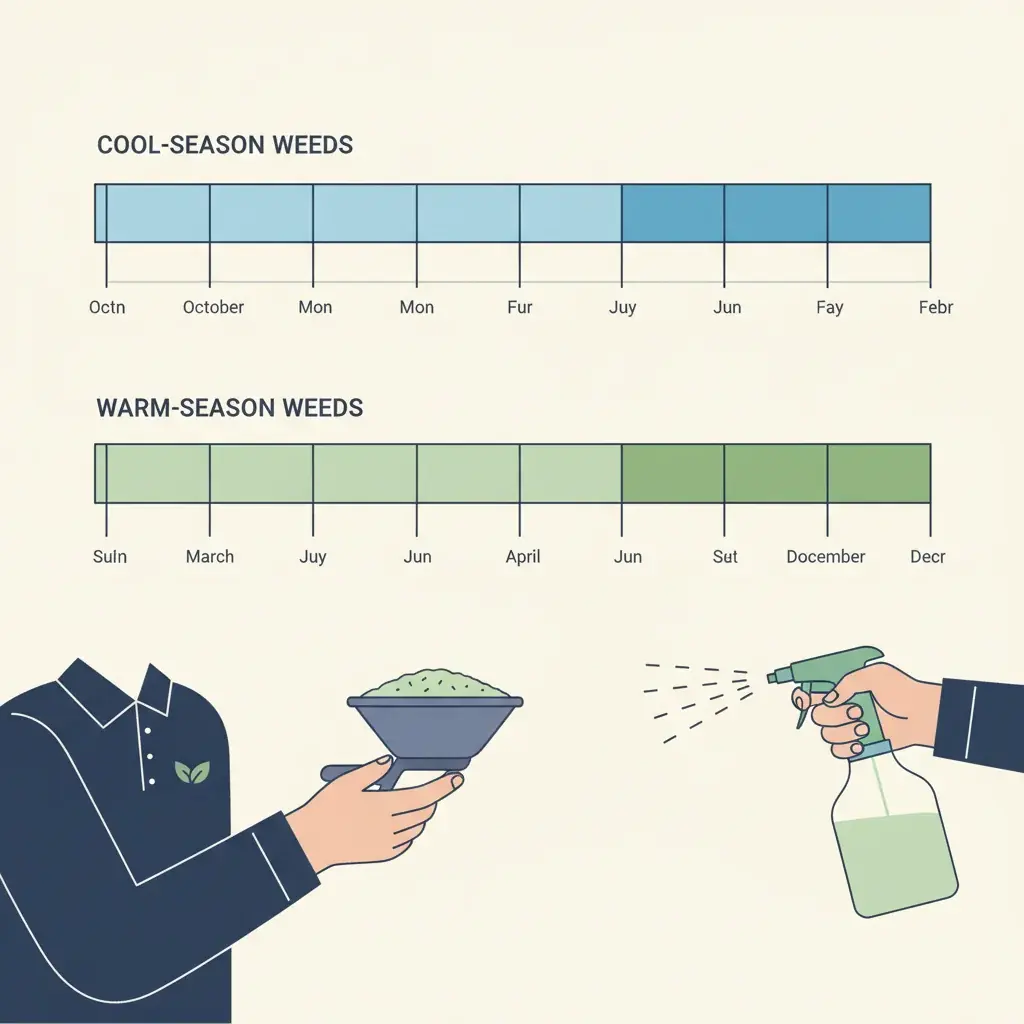
Late-winter window for warm-season weeds
For crabgrass, spurge, and goosegrass, apply before those seeds germinate. That can look early on a calendar. Coastal soil can warm sooner than inland soil in a warm year. Measure it; do not treat late January as a county appointment.
If those seeds have already germinated, you are in post-emergent territory. Waiting after a warm stretch means crabgrass in sunny, south-facing strips may already be up.
A few notes on product selection for the late-winter application:
Granular vs. liquid. Granular pre-emergents are easier for homeowners to apply evenly with a broadcast spreader. Liquid formulations provide more uniform coverage and are often preferred by weed control professionals for large or complex areas.
Residual length. Follow the label for how long the product is supposed to last. In a long warm season a single late-winter pass may not cover summer weeds. Ask whether a labeled second application belongs on the written plan.
Fertilizer combos. “Weed and feed” products combine pre-emergent herbicide with fertilizer. They’re convenient, but the timing rarely works for both goals simultaneously. For better results, keep your lawn fertilization program separate from your pre-emergent schedule so each product goes down at the right time.
Post-emergent options when you missed the window
Sometimes the window closes before you get to it. You look out at the lawn in April and crabgrass is already ankle-high in the sunny strips along the driveway. Pre-emergent won’t help at that point, you need a post-emergent approach.
For crabgrass, quinclorac is the most widely available selective post-emergent option for home lawns. It works on young plants (1–3 tillers) but loses effectiveness as crabgrass matures. Apply it early and expect to need two applications 7–10 days apart.
For oxalis, triclopyr-based products are more effective than standard broadleaf herbicides. Oxalis has a waxy cuticle that sheds many herbicides, adding a surfactant improves uptake significantly.
Spurge is easier to hand-pull when the soil is moist. For larger infestations, a broadleaf herbicide containing 2,4-D, MCPP, and dicamba (common “three-way” formulations) handles it well in cool weather.
Post-emergent herbicides on established weeds are harder to time and more likely to injure turf if applied off-label. Follow the product label. Missing a pre-emergent pass once is recoverable. Missing it every year is a larger job. UC Master Gardeners of San Diego County publish local gardening guidance if you want a second public source.
Organic vs synthetic: what works in SD lawns
Corn gluten meal is the most commonly cited organic pre-emergent. It does have pre-emergent activity, but it needs the label rate, consistent moisture, and precise timing. In San Diego’s dry springs, it often underperforms. It also adds nitrogen to the lawn, which can feed the weeds that slip through.
For lawns that need to stay chemical-free, near vegetable gardens, with children or pets on the turf, corn gluten meal is worth trying. Apply it at full label rate and water it in well. Corn gluten meal is usually weaker than a labeled synthetic pre-emergent. Use the label’s expected control language, not a remembered suppression percentage.
Synthetic pre-emergents like pendimethalin, prodiamine, and dithiopyr are common labeled turf products. Follow the label for rate, watering-in, and any site restrictions. UC IPM publishes pest and herbicide guidance. This page does not assign a risk rating.
If you’re on a buffalo grass or warm-season turf lawn, check the label carefully, some pre-emergents are not safe on all grass types. The best grass types for San Diego lawns blog post covers which turf varieties are most common here and what herbicide restrictions apply.
Frequently asked questions
When should pre-emergent go down in San Diego?
Two seasonal windows matter: winter weeds vs summer weeds. Soil temperature and the product label set the day, not a remembered mid-October or mid-February date. Once weeds are up, pre-emergent does not catch them.
Why does San Diego need weed control almost year-round?
Warm soil keeps weed pressure high in nearly every month here, unlike climates with a hard winter that resets the cycle. Spot treatment follows the weeds you actually see and the label, not a calendar. A maintenance plan that skips weed work quietly loses ground through the year.
Does mulch replace pre-emergent?
In beds it does a lot of the work. Three inches of mulch blocks enough light to suppress most germination, and depth matters more than which material you use. In turf, where you cannot mulch, timed pre-emergent is the tool that keeps annual weeds from establishing in the first place.
When to call us
Pre-emergent timing gets complicated fast when you’re managing a lawn with mixed sun exposure, patchy turf, or a history of heavy weed pressure. Getting the application rate wrong, too light and you lose coverage, too heavy and you can inhibit turf recovery or overseed germination. A referred weed control professional can time the window for the yard and quote labeled product they are licensed to apply. Call us at (760) 400-6355 to get matched. The independent professional quotes the work.