You’ve put in the work to keep your lawn green and healthy, then one morning you spot them: brown patches marring otherwise solid turf. These dead spots trace back to a short list of causes, and in San Diego’s climate the culprit isn’t always obvious. An accurate diagnosis comes before any fix.
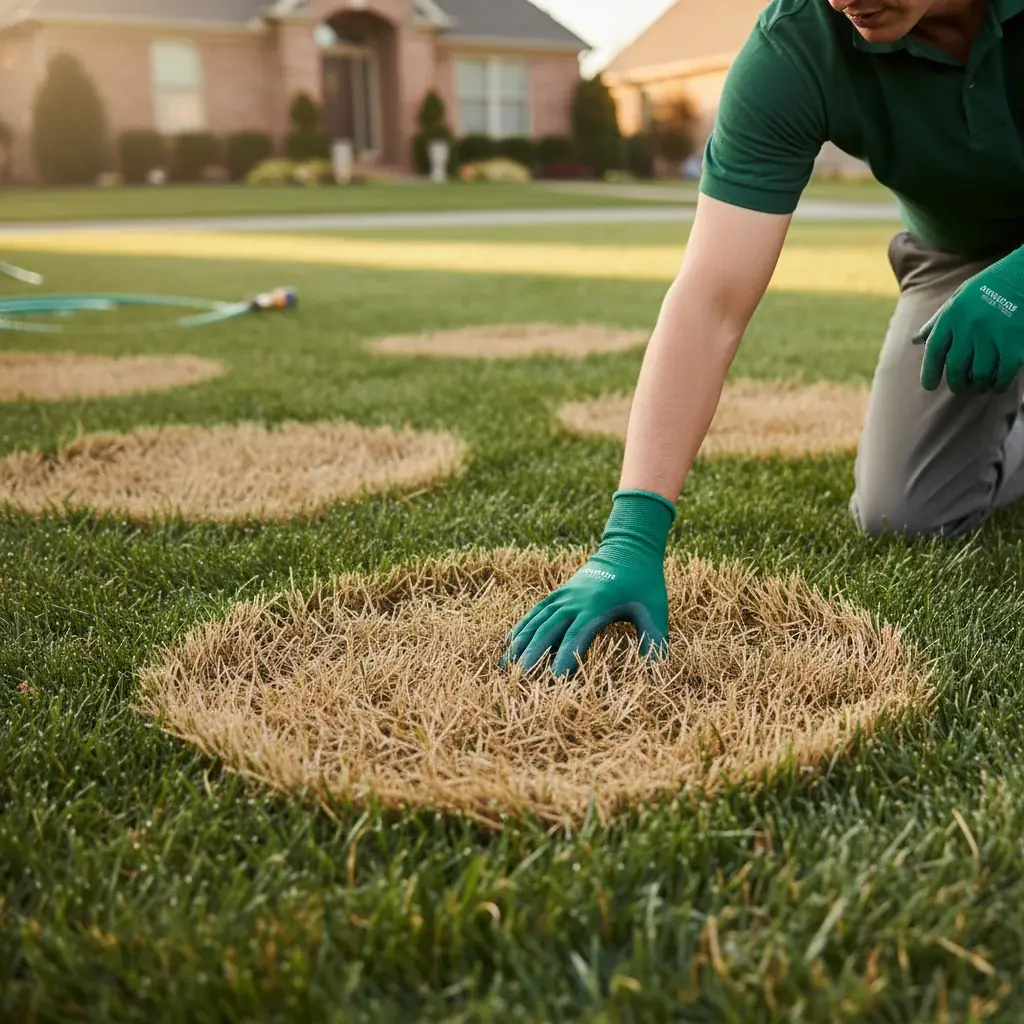
Dry spots vs disease vs grub damage: how to tell the difference
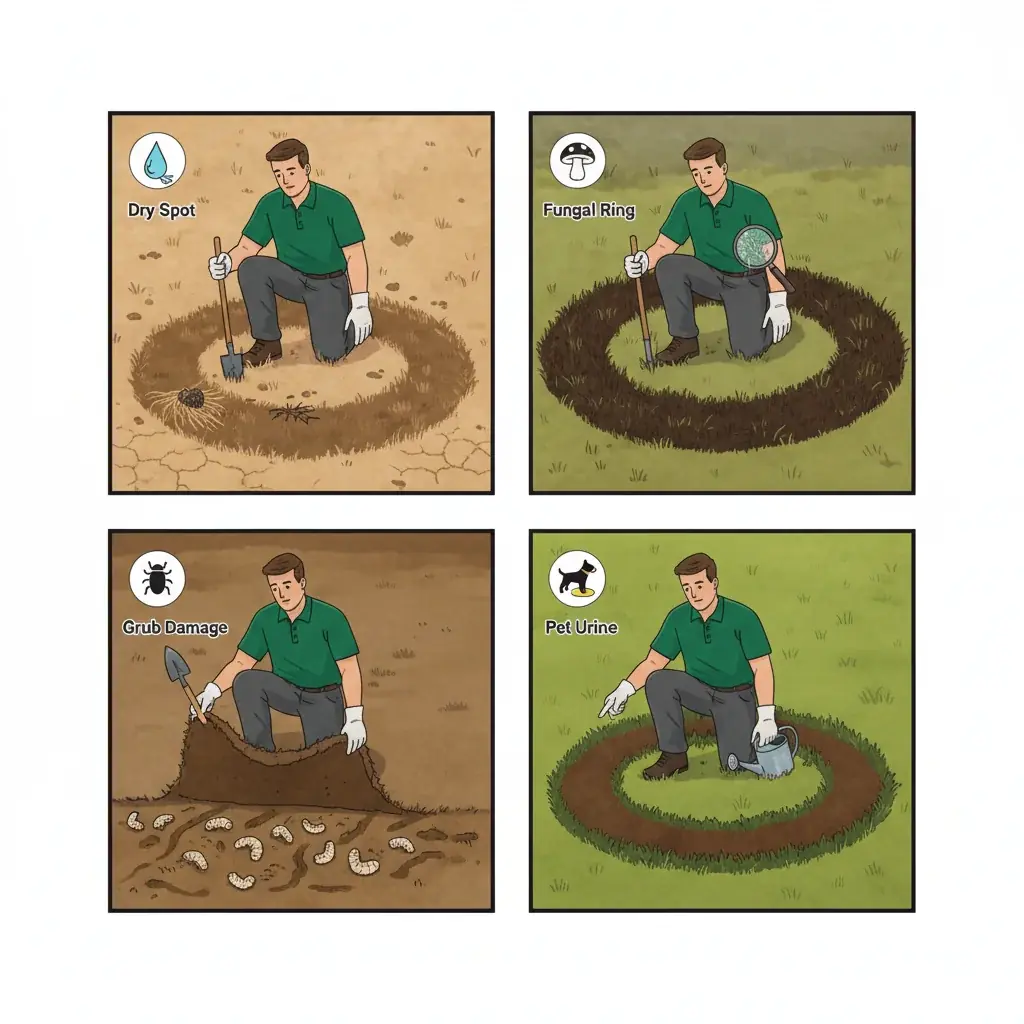
Brown patches in your lawn are symptoms, not the problem itself. The first step is to play detective and figure out which of the three main culprits is at work: water, disease, or pests. Each leaves behind distinct clues.
Possible dry spots: Wilted or discolored grass, dry soil, and a pattern that follows sprinkler coverage justify an irrigation check. UC IPM suggests probing soil moisture with an object such as a screwdriver, but resistance alone does not prove the cause because compaction and soil differences also matter.
Possible disease: Rings, defined margins, lesions, or visible growth can support further investigation, but different diseases and non-disease problems can look alike. Use the UC IPM lawn disease guide and confirm the turf species and symptoms before treatment.
Possible insect damage: Turf with damaged roots may pull back. Confirm the insect and abundance before considering treatment. See the UC IPM lawn insect guide rather than treating from a remembered frequency claim.
Sprinkler coverage gaps, the most common SD culprit
Before you blame pests or disease, check the irrigation system and soil moisture. UC IPM identifies poor watering practices as a main reason for dead and dying lawn areas. Even a programmed system can develop leaks, broken or misdirected heads, faulty valves, runoff, or uneven coverage.
Common culprits include:
- Clogged or Broken Sprinkler Heads: A single nozzle blocked by dirt or a head damaged by a lawnmower can leave a large triangular or circular patch of grass completely dry.
- Tilted Heads: Over time, soil settles and mowers bump heads, causing them to tilt. A tilted head sprays water over the sidewalk or into a hedge instead of onto your lawn.
- Poor Head-to-Head Coverage: Sprinkler systems are designed so the spray from one head reaches the next. If they are spaced too far apart or the pressure is too low, you get dry spots in the middle.
- Incorrect Nozzles or Pressure: Mismatched nozzles can cause uneven water distribution. Water pressure that’s too high creates mist that evaporates, while pressure that’s too low results in weak streams that don’t reach their target.
You can perform a simple “tuna can test” by placing several empty, flat-bottomed cans around your lawn and running your sprinklers for 20 minutes. Afterward, measure the water in each can. If some have significantly less water than others, you’ve found your coverage gaps. When troubleshooting reveals problems with heads, lines, or valves, a professional irrigation repair service is your best bet to ensure efficiency and compliance with local guidelines from entities like the San Diego County Water Authority.
Fungal disease in coastal humidity: rust, dollar spot, brown patch
San Diego’s coastal areas, with their “May Gray” and “June Gloom,” create the perfect humid, mild environment for fungal diseases to take hold. Overwatering, especially at night, poor drainage, and compacted soil can make things even worse. Three fungal issues common in coastal humidity are rust, dollar spot, and brown patch.
Lawn Rust: If you walk across your lawn and your shoes come away with an orange-yellow powder, you have rust. It weakens the grass but rarely kills it entirely. It’s most common on fescue and perennial ryegrass, especially when growth has slowed due to low nitrogen.
Dollar Spot: This disease appears as small, round, bleached-out or straw-colored spots about the size of a silver dollar. In the early morning, you might see a cobweb-like growth on the affected blades. These small spots can quickly merge into larger, irregular patches.
Brown Patch: True to its name, this disease causes large, roughly circular brown patches that can be several feet in diameter. It often features a grayish-brown “smoke ring” on the outer edge, which is most visible in the morning when there’s dew on the grass. Brown Patch thrives in hot, humid weather.
Fixing a fungal issue involves both treatment and prevention. You may need a targeted fungicide application. However, long-term health depends on changing the conditions that allowed the fungus to grow. This includes watering deeply but infrequently in the morning, improving air circulation by trimming nearby shrubs, and implementing a proper lawn fertilization & care program to keep your turf strong and resilient.
Grubs and chinch bugs in warm-season lawns
If turf pulls back easily, inspect the roots and soil; that symptom alone does not prove grubs. UC IPM identifies several California lawn insects whose larvae can damage roots and provides monitoring methods and treatment thresholds. Confirm what is present before choosing a response.
Chinch bugs are another common pest, especially in warm-season grasses like St. Augustine and Zoysia. These tiny insects are hard to see, but their damage is obvious. They inject a toxin into grass blades while they feed, causing the grass to turn yellow, then reddish-brown, and die. Chinch bug damage often starts in the hottest, sunniest parts of the lawn and expands outward. To check for them, part the grass at the edge of a damaged area and look for small black or red insects near the soil surface.
Do not apply an insecticide from symptoms alone. UC IPM recommends confirming that live insects exceed a treatment threshold, changing conditions that favor the pest, and using the least-toxic suitable option only when treatment is warranted. Product selection and application must follow the label.
Pet damage and salt spots near walkways
Sometimes the cause of brown spots is much closer to home, literally. Our furry friends and our hardscapes can both be sources of lawn damage.
Possible pet damage: UC IPM notes that dog urine can produce damage resembling insect or disease symptoms. If pet use repeatedly aligns with the spots, discuss surface, cleanup, soil, and irrigation options with a qualified lawn professional while following local water rules. The pattern still does not prove the cause by itself.
Salt and Chemical Damage: While we don’t use much de-icing salt in San Diego, salt damage can still occur. It’s most common near sidewalks and driveways where concrete runoff can alter soil pH. Pool splash-out is more common here than de-icing salt. Chlorine and saltwater pools can kill grass if enough water repeatedly splashes onto the same area. You might also see brown patches from accidental spills of gasoline, fertilizer, or herbicides. The solution for these spots is to first identify and stop the source, then flush the affected soil with water to leach out the contaminants before attempting to repair the turf.
When to repair vs reseed vs sod
Once you’ve diagnosed the cause of your brown patches and addressed the underlying issue, it’s time to fix the damage. Your approach depends on the size and severity of the problem.
Repair (for small spots): If you only have a few small spots less than six inches across, a simple patch-and-repair job is sufficient. First, use a hard rake to remove all the dead grass and thatch. Next, use a hand cultivator or trowel to loosen the top two inches of soil. Mix in a small amount of compost or quality topsoil, then sprinkle a pinch of grass seed that matches your existing lawn type. Lightly cover the seed with more soil, press it down firmly, and keep the area consistently moist until the new grass is established.
Reseed (for larger, thin areas): When damage is more widespread but not a total loss, overseeding is a great option. If most of the lawn has gone brown over summer, our guide to reviving a dead lawn in San Diego walks through whether it’s dormant or truly dead before you reseed. This involves spreading seed over the existing lawn to fill in thin areas and large patches. For best results in San Diego, this should be done in the spring or fall. It’s often paired with lawn aeration, which pulls small plugs of soil from the lawn to reduce compaction and allow seed, water, and nutrients to penetrate the soil more easily.
Sod (for extensive damage or instant results): If a large percentage of your lawn is dead or if you need an immediate green carpet, installing new sod is the best solution. While it’s the most expensive option, it provides an instant, mature lawn. Sod installation requires properly preparing the soil underneath by removing all the old turf, tilling, and adding amendments. Laying sod is labor-intensive and must be done correctly to ensure the roots establish well.
Frequently asked questions
What causes brown patches in a San Diego lawn?
Water, disease or pests, and they leave different clues. Drought stress looks wilted and gray-green before it goes uniformly straw-brown, and the ground under it is hard and dry. Fungal disease shows as rings or spots with distinct margins. Grub damage makes the turf feel spongy and lift like a rug. Improper watering is the single most common cause in San Diego.
How do I test whether a brown patch is a dry spot?
Compare soil moisture in the brown and green areas. Greater resistance can support a dry-soil or compaction hypothesis, but it does not prove sprinkler coverage is the sole cause.
Which lawn diseases are common in coastal San Diego?
Rust, dollar spot and brown patch, all encouraged by the humid mild conditions of May Gray and June Gloom. Rust is easy to identify: walk across the lawn and your shoes come away with an orange-yellow powder. It is most common on fescue and perennial ryegrass, especially when growth has slowed from low nitrogen. Overwatering, night watering, poor drainage and compaction all make these worse.
Should I repair, reseed, or re-sod the damage?
Match the fix to the size, and only after correcting the underlying cause. Spots under about six inches across take a simple patch and repair: rake out the dead material, loosen the top two inches of soil, and reseed. Larger areas justify reseeding or overseeding the whole zone, and widespread failure is where sod becomes the faster answer.
When to call us
Diagnosing brown patches requires observation and, for disease or insects, confirmation before treatment. Bloom Pro SD can match you with an independent landscaping professional who can inspect the site and propose a scope. Confirm diagnosis, licensing, product labels, and price directly with that contractor.
Call us at (760) 400-6355 to get matched. The independent professional quotes the work.