Oceanside is a jewel of North County San Diego, but its beauty comes with a unique challenge for homeowners: distinct microclimates. Depending on whether your home sits west of I-5 in the marine layer or east of College Boulevard where the sun bakes, your landscaping needs are surprisingly different. Getting your plant choices and irrigation right makes all the difference for a thriving, water-wise yard. If your focus is the turf itself, our lawn care guide for Oceanside covers mowing, watering, and seasonal timing for these microclimates.
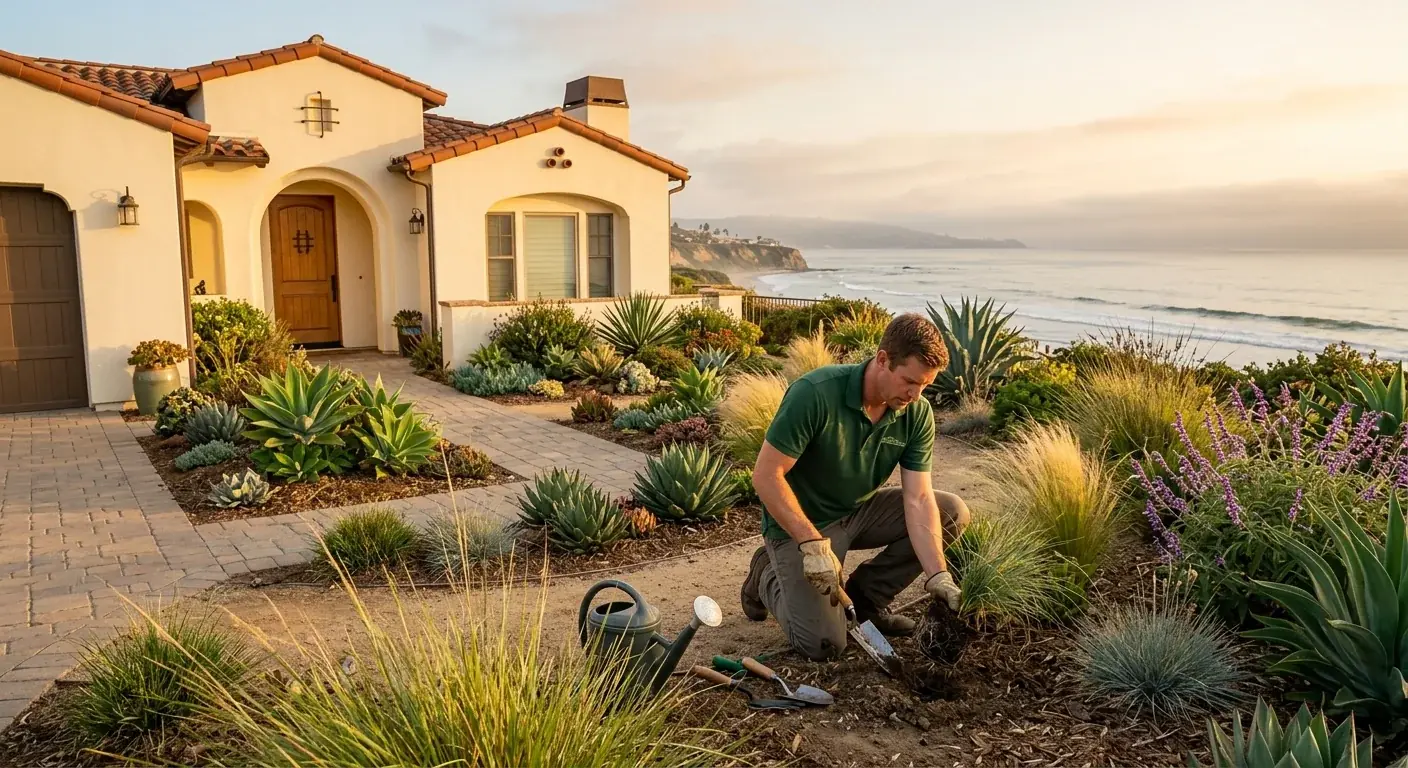
The Oceanside microclimate split: west of I-5 vs east of College
Oceanside isn’t just one climate zone. It’s a city bisected by subtle yet significant atmospheric shifts, creating two primary microclimates right in your backyard. Think of it like a natural dividing line for what truly thrives. West of Interstate 5, you’re firmly in the marine layer’s cool, humid embrace. This coastal strip benefits from consistently cooler temperatures, higher ambient humidity, and persistent morning fog. These conditions naturally reduce the need for irrigation and offer a buffer from extreme heat. However, this constant moisture also creates challenges, like increased risk of fungal diseases and root rot for species not adapted to continuous dampness.
Move east of College Boulevard, and the story changes dramatically. Here, the moderating influence of the ocean diminishes significantly. You’ll experience hotter, drier days, especially throughout the summer months. Diurnal temperature swings are often much larger, meaning scorching afternoons can give way to cooler nights, but the overall evapotranspiration (ET₀) rate is substantially higher. This means plants lose water to the atmosphere at a much faster pace, requiring different strategies for survival and thriving. A plant happy near the pier might struggle or even fail completely just a few miles inland. Understanding this fundamental split in Oceanside’s climate is the first step toward a successful and sustainable landscape design. It dictates everything from plant selection to your irrigation schedule, ensuring your investment truly flourishes exactly where it’s planted.
Plants that handle marine layer without rotting
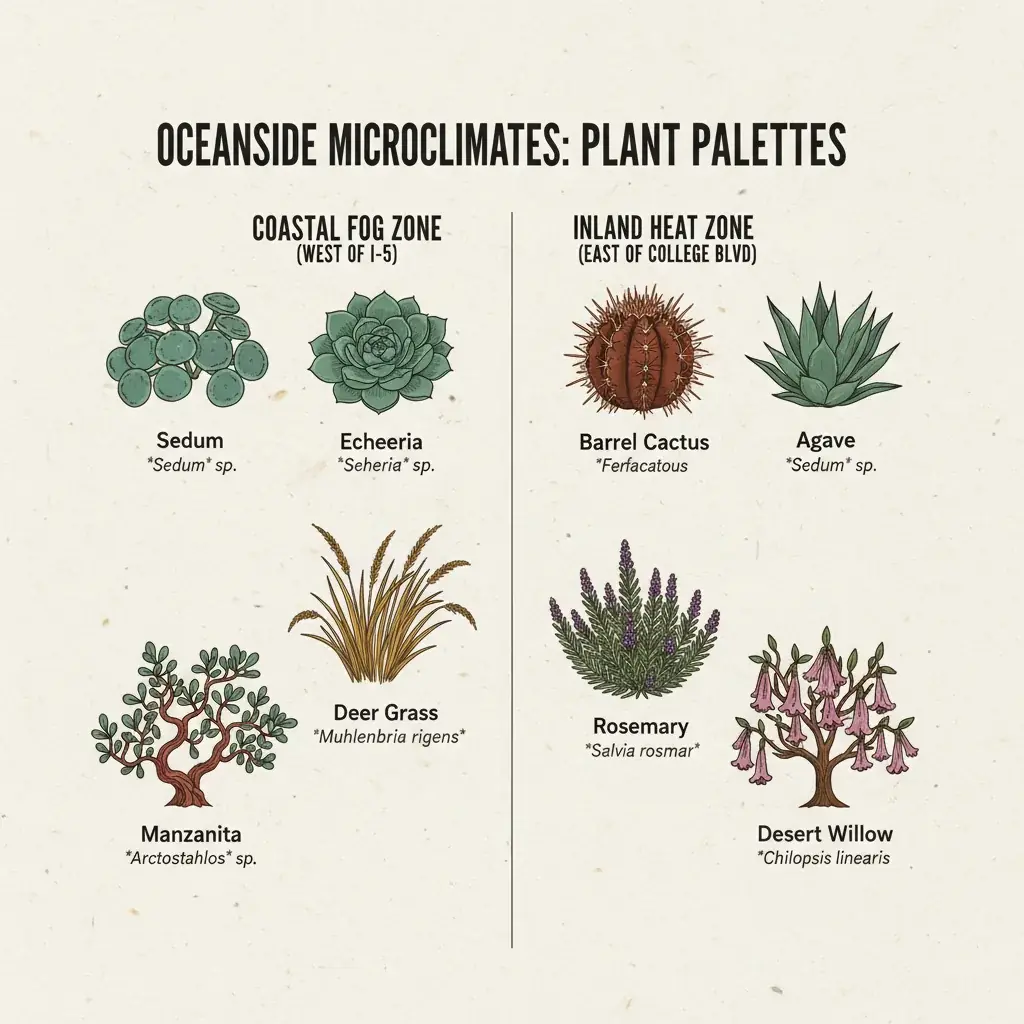
Coastal Oceanside landscaping demands plants that don’t just tolerate but actually thrive in cool, moist conditions. The marine layer, while a blessing for mild temperatures, can be a curse for species prone to rot or mildew. You’ll want to select plants with good air circulation around their foliage and those naturally adapted to humidity. Many native California plants are excellent choices, having evolved to handle this environment. Consider succulents like various types of Sedum or Echeveria, provided they have excellent drainage.
Ornamental grasses such as Deer Grass (Muhlenbergia rigens) or California Fescue (Festuca californica) also perform well, offering texture and movement without succumbing to rot. For shrubs, think about varieties of Manzanita (Arctostaphylos) or Toyon (Heteromeles arbutifolia), which are both drought-tolerant and well-suited to coastal conditions. Avoid plants that prefer consistently dry soil, especially around their crowns, as these will quickly suffer. Your goal is a vibrant, low-maintenance garden that can breathe, even on the fuzziest Oceanside mornings. Remember that healthy soil with good drainage is paramount in these conditions; it prevents water from sitting and causing issues at the root level.
Heat-tolerant species for inland Oceanside neighborhoods
Shifting to inland Oceanside, your plant palette needs a complete recalibration. East of College, the sun is more intense, and the air is much drier. Here, the focus shifts to species known for their resilience against heat, prolonged sun exposure, and lower water availability. Many stunning drought-tolerant plants excel in these conditions, creating beautiful landscapes that require minimal water once established.
Agaves and cacti are natural champions for inland heat zones. Their succulent leaves and stems store water, allowing them to withstand long dry spells. Varieties like Agave attenuata (Foxtail Agave) or various smaller barrel cacti can add dramatic architectural interest. Mediterranean natives, such as Rosemary (Salvia rosmarinus) and Lavender (Lavandula species), also thrive, offering fragrant foliage and beautiful blooms. For larger shrubs and trees, consider California Lilac (Ceanothus species) or Desert Willow (Chilopsis linearis). These plants not only tolerate the heat but often prefer it, making them perfect for creating a vibrant, water-wise garden that stands up to Oceanside’s hotter zones. When planning your inland landscape, prioritize plants with low water needs and a proven track record for enduring higher temperatures and direct sun. These choices will ensure your yard looks great without demanding excessive irrigation.
Irrigation tweaks for fog-heavy mornings
In coastal Oceanside, morning fog can reduce evaporation, but it is not a substitute for checking soil moisture. UC IPM generally favors watering early, when wind and evaporation are lower, and says to shut irrigation off in rainy weather. Do not treat fog as a scheduled irrigation event. If foliage stays wet into the evening, that is a disease-risk observation to raise with the contractor, not a reason to water at midday as a county rule.
Inland lots often dry faster. Deep, infrequent watering is the usual established-plant goal after roots are down. A weather-based controller can help if it is programmed to the plants, soil, and agency rules. Confirm any rebate on the current SoCal Water$mart page for your address, not a remembered adder.
Rebate stack: Tri-Cities and MWD adders for Oceanside addresses
Oceanside addresses may qualify for regional turf-replacement and irrigation-device programs administered through SoCal Water$mart and the water agency on the bill. Do not assume a named local adder or a stacked per-square-foot amount. Confirm the current program, eligibility, and reservation rules before turf is removed. Synthetic turf is not eligible on the regional turf-replacement path. See drought-tolerant rebates in San Diego for the comparison questions.
When to call a designer for a split-zone lot
Designing a landscape that accounts for Oceanside’s distinct microclimates is more complex than a typical garden project. If your property spans both coastal and inland conditions, or if you simply want to maximize efficiency and beauty, calling a professional landscape designer is a wise investment. A skilled designer understands how to map your specific microclimates, select appropriate plants for each zone, and create an irrigation system that precisely delivers water where and when it’s needed – no more, no less.
They can help you choose the right balance of plants that thrive in fog, tolerate heat, or even bridge the gap between the two. This expertise prevents costly mistakes, like planting sun-loving species in damp, shady areas, or conversely, delicate plants in scorching, exposed spots. A designer also ensures your landscape complies with local water-efficiency regulations and helps you navigate the rebate process. For complex properties or if you’re aiming for a cohesive, sustainable, and beautiful outdoor space, professional landscape design ensures your vision comes to life effectively. Always confirm your designer holds a valid California contractor’s license by checking the CSLB website.
Frequently asked questions
Does Oceanside have more than one climate?
Two, effectively. West of Interstate 5 you get the full coastal influence: marine layer, moderated temperatures, salt in the air. East of College Boulevard the ocean’s moderating effect drops off sharply, giving hotter, drier days through summer and wider day-to-night temperature swings. The same plant list will not serve both.
What plants suit coastal Oceanside?
Species that handle cool, moist conditions without rotting. Ornamental grasses like deer grass and California fescue perform well and add movement without succumbing to rot. Manzanita and toyon are reliable shrubs. The failure mode near the coast is not drought, it is mildew and rot in species that want dry air.
What plants suit inland Oceanside?
Heat and drought specialists. Agaves and cacti are the natural champions east of College, storing water in leaves and stems to ride out long dry spells. Agave attenuata and smaller barrel cacti add architectural structure. The palette has to be recalibrated completely from a coastal list, not just thinned out.
How should irrigation differ across the two zones?
Coastal Oceanside often evaporates less than inland lots, so the same timer setting can overwater one and underwater the other. Deep, infrequent watering is the usual established-plant goal inland. If a property straddles both, ask for separate irrigation zones rather than one averaged schedule. Fog is not a watering day.
When to call us
Navigating Oceanside’s diverse microclimates for your landscaping project demands specialized knowledge and experience. If you’re ready to transform your yard with a design that truly works with your unique environment, or if you need expert guidance on plant selection and irrigation, the pros in our network are here to help. We’ll match you with a licensed independent landscaper who can walk the lot. Bloom Pro SD does not guarantee a water-wise result. Call us at (760) 400-6355.