Cut your San Diego water bill: irrigation repair and smart controllers

The average SD water bill is 30-50% higher than it needs to be because of invisible irrigation waste. Broken valves, leaking laterals, over-programmed controllers, and nozzles spraying the driveway add up fast at 2026 water rates.

This is what to check, what to fix, and what payback to expect.

The 3 most common invisible leaks

1. A leaking valve (most common, biggest cost)

Symptoms:

  • Wet spot on the lawn that never fully dries
  • Water bill climbs without usage changes
  • Some zones “weep” water when they’re supposed to be off
  • Moss or mushrooms near the valve box

Root cause: a worn diaphragm, stuck solenoid, or cracked valve body. Results in continuous flow even when the zone is not running.

Cost of ignoring it: A failed valve can waste 25,000-60,000 gallons per year. At SD Tier 2 rates (roughly $10/CCF in most agencies), that’s $330-$800/year down the drain.

Fix: Valve rebuild or full replacement. A Hunter PGV or Rain Bird DV runs $180-$320 installed. Payback inside 6-8 months on a single valve leak.

2. A cracked lateral line

Symptoms:

  • Always wet spot, even more than a valve leak
  • Drop in pressure on one zone
  • Mud or erosion in a landscape bed
  • Tree root upheaval near the line

Root cause: tree roots, ground settling, or an old PVC glue joint failing.

Cost of ignoring it: A mainline leak runs 24/7 at full pressure and can waste 50+ gallons per hour. Catching a mainline leak a month late can cost $200-$400 on the bill.

Fix: Locate the break, dig, and glue a repair section. $220-$450 typical. Emergency work (water shut off to the house until repair) is higher.

3. Over-programmed controller

Symptoms:

  • Every zone set to “run daily” at peak depth
  • No seasonal adjustment on a non-smart controller
  • Zones running right after it rains
  • Pop-up spray zones running 20+ minutes per cycle

Root cause: homeowner or prior owner set it once and never adjusted, or a landlord set generous times “so tenants don’t complain.”

Cost of ignoring it: Over-watering is the #1 source of SD water waste. Typical home over-irrigated by 2x uses an extra 20,000-40,000 gallons per season.

Fix: Reprogram the controller to match current water district restrictions and actual plant needs. Free to do, if you know what you’re doing. Or a smart controller does it automatically (see below).

Smart controllers: worth the cost?

Short answer: yes for most SD homes.

A smart controller (Rachio, Hunter Hydrawise, Rain Bird ESP-TM2, Weathermatic) connects to WiFi and pulls local evapotranspiration (ET) data — basically how much water the plants have lost to evaporation and transpiration based on temperature, humidity, wind, and solar radiation in the last 24 hours. It then waters to replace exactly what was lost.

What that does in practice:

  • Skips watering after rain (big deal in SD’s January-February rain)
  • Reduces watering in cool, humid weather (May marine layer, September coastal fog)
  • Increases watering in Santa Ana wind events (when plants lose water 2-3x faster)
  • Auto-complies with water district watering day rules (no brain-power required from you)

Typical savings

Most SD homes see 30-50% reduction in outdoor water use after a smart controller install and tune-up. That translates to:

  • Small yard (under 2,000 sq ft turf) — $15-$30/month savings → $180-$360/year
  • Standard yard (2,000-4,000 sq ft) — $30-$60/month savings → $360-$720/year
  • Large yard (4,000+ sq ft or multi-zone drought design) — $60-$150/month savings → $720-$1,800/year

Costs and rebates

  • Rachio 3 (8-zone): $230 unit cost + $50-$100 installation = $280-$330 total
  • Hunter Hydrawise (12-zone pro unit): $320 + installation = $380-$450 total
  • Rebates: $125-$325 back from most SD water agencies on a WaterSense-certified unit
  • Typical net cost after rebate: $150-$250

Payback: 6-14 months on the water bill savings alone for most homes. After that, it’s pure savings for the life of the controller (typically 10+ years).

Nozzle upgrades: the small retrofit with outsized returns

If your system is 10+ years old, it’s probably running old fan-spray pop-up nozzles — wasteful, uneven precipitation, and inefficient.

Upgrade to matched precipitation rate (MPR) nozzles or rotary stream nozzles (MP Rotators, Rain Bird R-VAN):

  • Use 20-30% less water for the same coverage
  • Much more uniform distribution (no dry spots)
  • Work better at low pressure
  • Resist wind drift far better

Cost: $6-$12 per nozzle installed. A 10-zone residential yard is roughly 25-40 nozzles — $180-$400 total. Payback inside 6-12 months on water savings.

What a pro audit catches

A walk-through audit covers everything above plus:

  • Pressure check at the head — too-high pressure (above 45 PSI at a spray head) wastes water and wears out heads faster
  • Matched-precipitation verification — nozzles in the same zone should have matched output rates
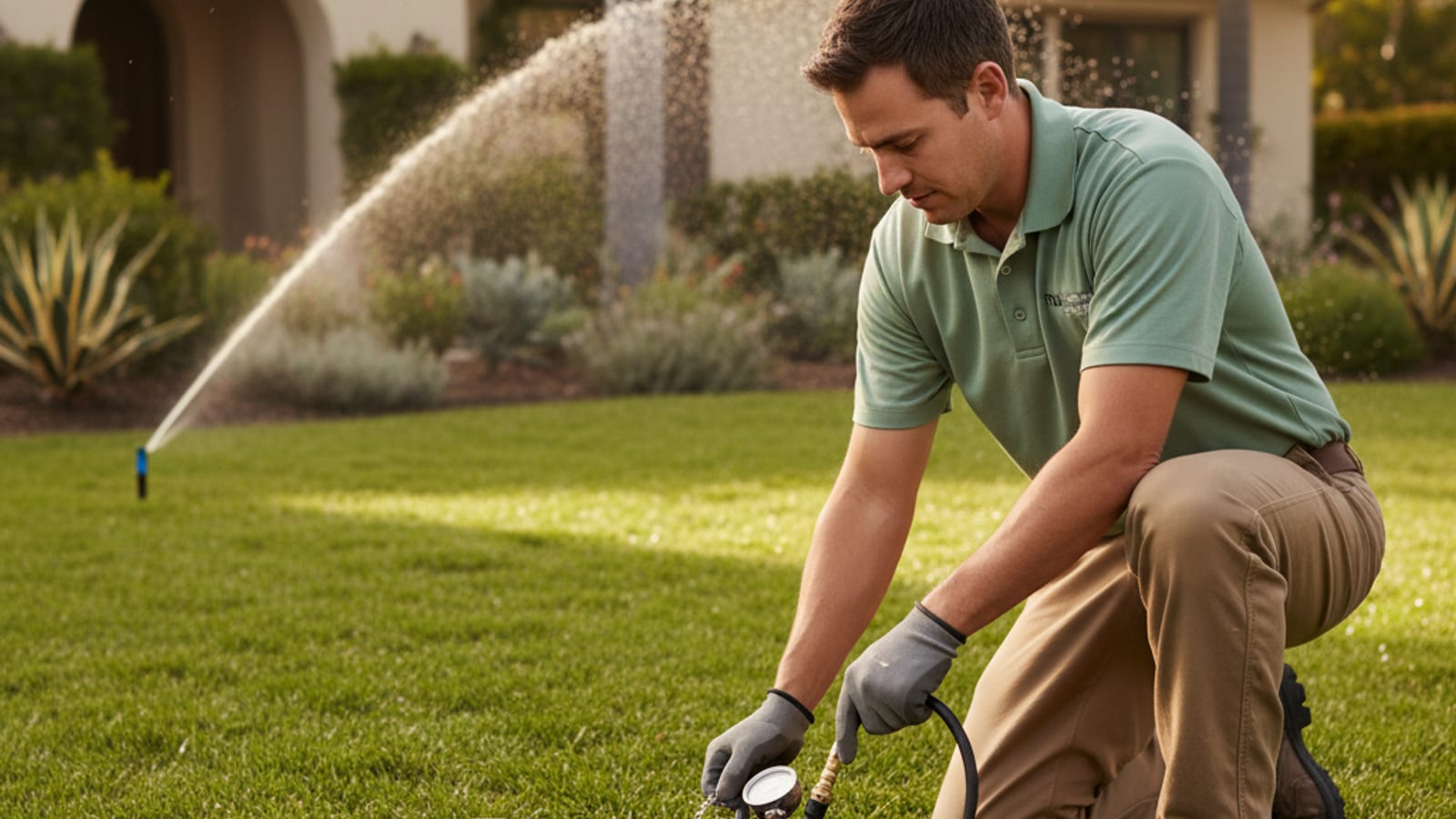
  • Valve-by-valve leak check with shut-off pressure test
  • Controller programming review against current water district restrictions
  • Rain sensor / flow sensor installation if the system lacks them

Typical audit: $95-$150 (credited toward any repair work we perform). Most audits find $250-$700 worth of needed fixes, and those fixes usually pay back in under a year.

When to DIY vs. call a pro

DIY worthwhile:

  • Replacing a single broken head
  • Changing a nozzle
  • Basic controller programming
  • Turning up run times before summer

Call a pro:

  • Leaks you can’t locate visually
  • Valve replacement (it seems simple, isn’t — the threads are finicky, and the wiring has to be right)
  • Smart controller install (the physical install is easy, the zone programming and rebate paperwork are not)
  • Mainline leaks or lateral breaks
  • Full system overhaul or drip retrofit

Get a quote

We handle irrigation diagnosis, repair, smart controller installs, and rebate paperwork for all SD County water agencies. Most diagnoses happen in a single visit and we can quote the fix on the spot.

Call (858) 808-6055 or use the contact form.